Most companies did not plan to end up with dozens of AI tools. A chatbot here, a writing assistant there, an AI feature switched on inside the CRM, a pilot in finance, another in marketing. Each one looked useful on its own. Two years later, many businesses have a pile of AI subscriptions that do not share data, do not talk to each other and are hard to measure, while leadership asks the obvious question: where is the return?
New research published on 7 October 2026 puts numbers on the problem. A study by WSJ Intelligence and Code and Theory found that large companies run an average of 183 AI tools, that 85% of executives describe their AI stacks as disconnected or siloed, and that only 15% of AI investments work as one unified system. The fix is not another tool. It is AI integration: connecting your AI to your data, your systems and each other so it can deliver results.
This article explains what the study found, what AI integration means in plain language, why AI tools end up disconnected, what AI tool sprawl really costs, and a practical 7-step plan to connect your tools and prove AI ROI, whether you are a large enterprise or a growing business with a handful of AI apps.
At a Glance
- The news: 801 C-suite executives at large US companies report an average of 183 AI tools, with only 15% of AI investments operating as a unified system (WSJ Intelligence and Code and Theory, October 2026).
- The pressure: 85% say AI must now deliver measurable ROI.
- The blockers: culture and siloed mindsets (61%), fragmented data (58%) and the lack of a central operating layer (56%) are cited more often than budget (29%).
- The fix: AI integration: shared data, connected systems, clear ownership and measurement, rather than more standalone tools.
- The market: demand for AI implementation services is growing. TCS reported on 8 October 2026 that its annualised AI revenue passed US$3.1 billion, over 10% of its total revenue.
The News: 183 AI Tools, Only 15% Working Together
The report, titled The Orchestration Gap: Why AI Investment Isn't Driving Enterprise Performance, surveyed 801 C-suite executives (CEOs, CTOs and CIOs, and CMOs) at US companies with at least $500 million in annual revenue. Its key findings:
- Companies have an average of 183 AI tools.
- 85% of organisations describe their AI stacks as disconnected or siloed, and lack the systems to connect their technology.
- Only 15% of AI investments operate as a unified system with information and insights shared across the business.
- 94% say better orchestration of their tools is essential to growth.
- 85% say AI must now deliver measurable return on investment.
- Three in five executives say tool proliferation has left strategic execution stagnant, and two-thirds of organisations routinely uncover redundant AI investments.
- One in four companies admit no one is clearly accountable for coordinating AI across the business.
- 78% say their customer-facing channels lack a unified data model.
- Only 18% apply the same governance and accountability standards to AI agents that they apply to human leaders.
One caveat: these are self-reported survey answers from very large US companies, not audited measurements, and the study was produced by an agency that sells orchestration services. Even so, the pattern will sound familiar to many smaller businesses too: lots of AI, little connection, and difficulty proving value.
What Is AI Integration?
AI integration means connecting AI to the data, software and workflows a business already runs on, so that AI can use accurate information, take actions in real systems and share what it learns across teams. It is the difference between an AI tool that sits on the side and an AI capability that is part of how the business works.
In practice, AI integration covers four layers:
- Data integration: giving AI access to clean, current data from your CRM, ERP, help desk, website and documents, with the right permissions.
- System integration: connecting AI to the applications where work happens, through APIs, so it can create a lead, update an order or draft a reply where your team already works.
- Workflow integration: placing AI at specific steps of a process, with clear handoffs to people, instead of leaving it as a separate app staff must remember to open.
- AI orchestration and governance: one place to manage which AI does what, who owns it, what it costs and how it is measured.
Many businesses already use AI. Far fewer have integrated it. That gap is where most of the lost value sits.
Why AI Tools End Up Disconnected
The study's list of barriers is revealing because the biggest ones are not technical or financial:
1. Every team buys its own AI (culture: 61%)
Marketing picks a content tool, sales turns on a CRM add-on, support signs up for a chatbot. Each choice is reasonable; together they create AI tool sprawl with overlapping features and no shared view of the customer.
2. Data lives in silos (fragmented data: 58%)
AI is only as good as the data it can reach. When customer data is split across a CRM, spreadsheets, WhatsApp chats and an e-commerce platform, each AI tool sees only a slice, and answers become inconsistent.
3. There is no central layer (56%)
Without a common platform or integration layer, every connection is built one tool at a time, or not at all. Information cannot flow from one AI to the next.
4. Nobody owns AI (one in four)
When no single person or team is accountable for AI across the business, nobody retires redundant tools, sets standards or measures results.
5. Skills gaps (38%)
Connecting AI to legacy systems, APIs and data pipelines needs engineering skills many teams do not have in-house. Notably, budget (29%) ranked lower than all of these.
The Hidden Cost of AI Tool Sprawl
Disconnected AI is expensive even when each tool seems cheap:
- Paying twice: two-thirds of organisations in the study routinely find redundant AI investments, tools that do the same job in different departments.
- Inconsistent answers: a chatbot quoting one price while a sales email quotes another damages trust, and 78% say their customer-facing channels lack a unified data model.
- Manual copy-paste: staff move AI output from one system to another by hand, which wastes the time AI was meant to save.
- Risk: customer and company data spread across many AI vendors is harder to secure and govern, and only 18% hold AI agents to the same accountability standards as people.
- Stalled strategy: three in five executives say tool proliferation has left strategic execution stagnant.
For a view on where AI budgets are heading, see our AI spending 2026 guide.
How to Fix It: AI Integration in 7 Steps
- Audit your AI. List every AI tool and feature in use, who uses it, what it costs, what data it touches and what it is for. Many businesses are surprised by the total.
- Assign ownership. Name one accountable owner for AI across the business, supported by a small group from IT, operations and the main business teams.
- Pick outcomes, not tools. Choose two or three measurable goals, such as faster lead response, fewer support tickets or less manual data entry, and judge every AI tool against them.
- Consolidate. Retire tools that overlap, and standardise on fewer platforms that can share data.
- Connect the data. Build a reliable data foundation: integrate your CRM, ERP, help desk and other core systems through APIs and data pipelines so AI works from one version of the truth. Our guide to AI-ready data covers this step in depth.
- Integrate AI into workflows. Put AI where the work happens: inside the CRM, the help desk or WhatsApp, with clear human handoffs. Where a task spans several systems, an AI agent can coordinate the steps.
- Govern and measure. Set rules for data access, accuracy and review, apply the same accountability to AI agents as to people, and report results monthly.
What an Integrated AI Stack Looks Like
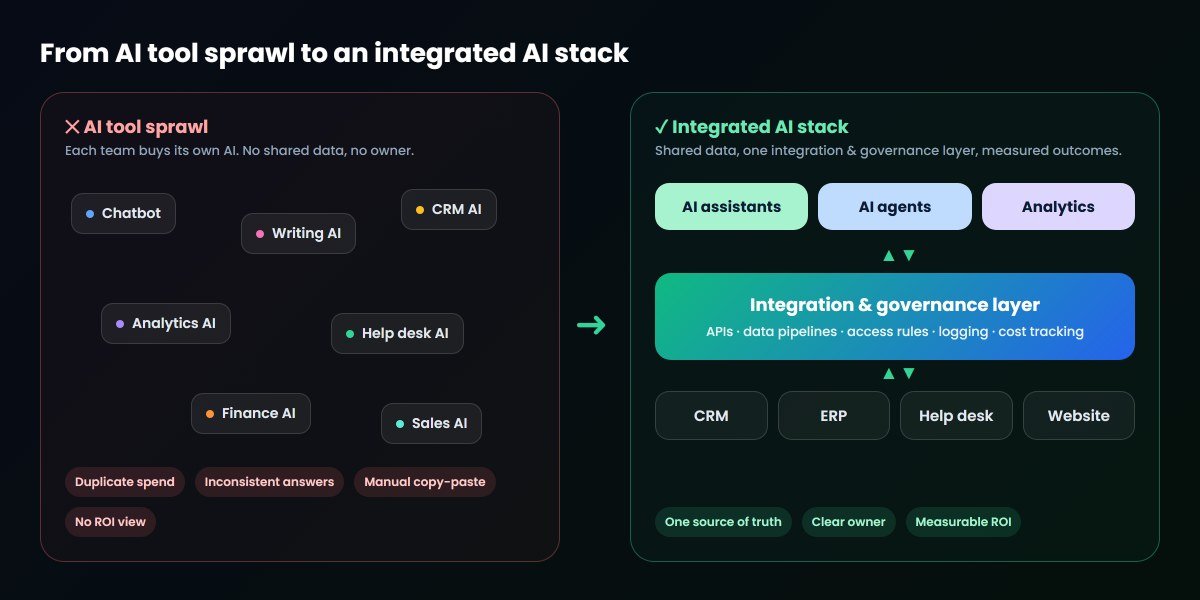
An integrated AI stack usually has three layers:
- Systems of record: your CRM, ERP, help desk, e-commerce platform, website and documents.
- An integration and governance layer: APIs, data pipelines, access rules, logging and cost tracking that connect those systems to AI in a controlled way.
- AI capabilities: assistants, AI agents, chatbots and analytics that all draw on the same data and write results back to the same systems.
With this structure, adding a new AI capability means plugging into the layer, not building another island. It also makes switching AI models easier as the market changes. If older systems are the bottleneck, legacy application modernisation may be the first step.
What This Means for Startups and SMEs
The study surveyed large companies, but smaller businesses face the same problem at a smaller scale: a few AI tools, data in separate apps, and no time to connect them. The good news is that integration is easier to fix early:
- Choose platforms that connect. Prefer tools with open APIs and integrations over closed apps. Our build vs buy guide explains when custom software makes sense.
- Start from the CRM. Make your CRM the hub that other tools read from and write to; our CRM integration guide shows how.
- Automate one end-to-end process first, such as lead capture to follow-up, instead of adding AI features everywhere.
- Use the right partner. You do not need a large in-house AI team. Demand for AI implementation is growing fast: TCS reported annualised AI revenue above US$3.1 billion, over 10% of its revenue, in results announced on 8 October 2026. Smaller businesses can get the same expertise through a specialist partner or a dedicated development team.
How to Measure AI ROI
With 85% of executives saying AI must now deliver measurable return, every AI integration project needs clear metrics from day one:
| Area | Example metric |
|---|---|
| Cost | Total AI spend per month, and spend removed by retiring overlapping tools |
| Time | Hours of manual work saved per week in a specific process |
| Sales | Lead response time and lead-to-customer conversion |
| Service | Share of requests resolved without a handoff, and customer satisfaction |
| Quality | Error rate and how often AI answers need correcting |
| Adoption | Share of the team actively using the integrated AI each week |
Measure a baseline before you start, then compare monthly. Our enterprise AI agents ROI guide has more examples.
Conclusion
The AI race is moving from adoption to integration. The October 2026 research is a clear signal: owning more AI tools does not create value on its own; connecting them does. Companies that audit their AI, assign ownership, connect their data and systems, and measure outcomes will get far more from the same budget than those who keep adding apps. Gartner predicts that by 2029 agentic AI will autonomously resolve 80% of common customer service issues, and agents like these can only work well on top of connected data and systems.
Whether you have 5 AI tools or 50, the next step is the same: make AI integration a priority, starting with the processes that matter most to your customers and your bottom line.
Frequently Asked Questions
What is AI integration?
AI integration is connecting AI to the data, software and workflows a business already uses, so AI can work with accurate information, take actions in real systems and share results across teams, instead of running as separate tools.
What is AI tool sprawl?
AI tool sprawl is the build-up of many AI tools across a business, often bought by different teams, that overlap, do not share data and are hard to govern or measure. The October 2026 WSJ Intelligence and Code and Theory study found large companies average 183 AI tools.
Why do AI projects fail to deliver ROI?
Common reasons include disconnected data, tools that are not built into real workflows, no clear owner, and no agreed metrics. In the 2026 study, culture (61%), fragmented data (58%) and the lack of a central operating layer (56%) were cited more often than budget (29%).
What is AI orchestration?
AI orchestration is coordinating multiple AI tools, models and agents so they work together through shared data, clear rules and one place to manage them, rather than each operating on its own.
How long does an AI integration project take?
An AI audit and plan can take a few weeks. Connecting one core process, such as lead capture to CRM follow-up, can often go live in a few weeks to a couple of months, depending on the systems involved. Larger programmes are delivered in phases.
How can CodeBase Coders help with AI integration?
CodeBase Coders starts with a short AI audit of the tools, data and workflows you already have, then designs and builds the connections: shared data pipelines, API integrations with your CRM, ERP and help desk, AI agents that work across systems, and dashboards that show ROI. Explore our AI integration services, AI consulting, software and API integration and AI governance consulting, or book a free consultation.
Sources
- WSJ Intelligence and Code and Theory (7 October 2026): 85% of the C-Suite Say Their AI Tech Stacks Are Disconnected
- PPC Land: 1 in 4 big US firms has no one in charge of AI, Code and Theory finds (study methodology and limitations)
- Free Press Journal: TCS Q2 FY27 results (8 October 2026): AI revenue above US$3.1 billion
- Gartner (5 March 2025): Agentic AI will autonomously resolve 80% of common customer service issues by 2029
Work With CodeBase Coders
CodeBase Coders helps businesses turn ideas into scalable digital products and improve existing processes through software, automation, AI, integrations and modern web technologies. For AI integration, we audit your current tools, connect your data and systems, build AI agents and assistants into your real workflows, and set up the governance and dashboards to prove ROI.
- AI Integration Services
- AI Consulting
- AI Agent Development
- AI Governance Consulting
- Software & API Integration
- Data Science & Analytics Services
- Dedicated Development Team
Too many AI tools and too little return? Book a free AI integration consultation with CodeBase Coders and we will map out where to connect, consolidate and automate first.
Rohan Verma
Founder, CodeBase CodersRohan Verma is the founder of CodeBase Coders. He helps startups, SMEs and enterprises turn ideas into scalable digital products and improve business processes through custom software, AI, automation, integrations and modern web technologies.