Patients now look a doctor up online before they visit. They want to know your qualifications, where the clinic is, when you sit, what a consultation costs and how to book. If they cannot find that quickly, they call the next clinic. So what is the real clinic website development cost, and what should a medical website contain?
There is a second question every doctor now has to ask. On 6 October 2026 the National Medical Commission (NMC) published new Guidelines on Ethical Advertising and Public Communication, and they name websites directly. A website that was normal last year, with "best doctor" lines, before-and-after photos and patient testimonials, can now lead to action by your State Medical Council.
This guide gives you our real 2026 starting prices for doctor, clinic and hospital websites, explains in plain words what the new NMC guidelines allow and rule out, and lists the features that help patients without breaking the rules. It is written for doctors, clinic owners and hospital administrators, and for the people who manage their websites.
At a Glance
- Doctor profile site: ₹8,000, for one doctor with qualifications, timings, fees and location.
- Clinic website: ₹12,000 – ₹20,000, with a page for each treatment and an appointment request form.
- Hospital or nursing home website: ₹12,000 – ₹20,000 to start, with a doctor directory and departments.
- Online booking or patient portal: ₹50,000 – ₹1,50,000, with slot booking and patient logins.
- New NMC rules: show names, qualifications and registration numbers; leave out "best" claims, before-and-after photos, testimonials and paid reviews.
- Every year after launch: roughly ₹10,000 to ₹15,000 for a domain, hosting and two email accounts at normal renewal prices.
Clinic Website Development Cost: Price List
These are CodeBase Coders' starting prices in 2026 for design and development. Domain, hosting and email are paid separately.
| Type of website | Starting price | Usual time to build | Best for |
|---|---|---|---|
| Doctor profile site | ₹8,000 | 1 to 2 weeks | One doctor, one clinic |
| Clinic website | ₹12,000 – ₹20,000 | 1 to 3 weeks | Clinics, polyclinics, dental and eye clinics |
| Hospital or nursing home website | ₹12,000 – ₹20,000 | 1 to 3 weeks | Several doctors and departments |
| Online booking or patient portal | ₹50,000 – ₹1,50,000 | 6 to 12 weeks | Busy practices that book by slot |
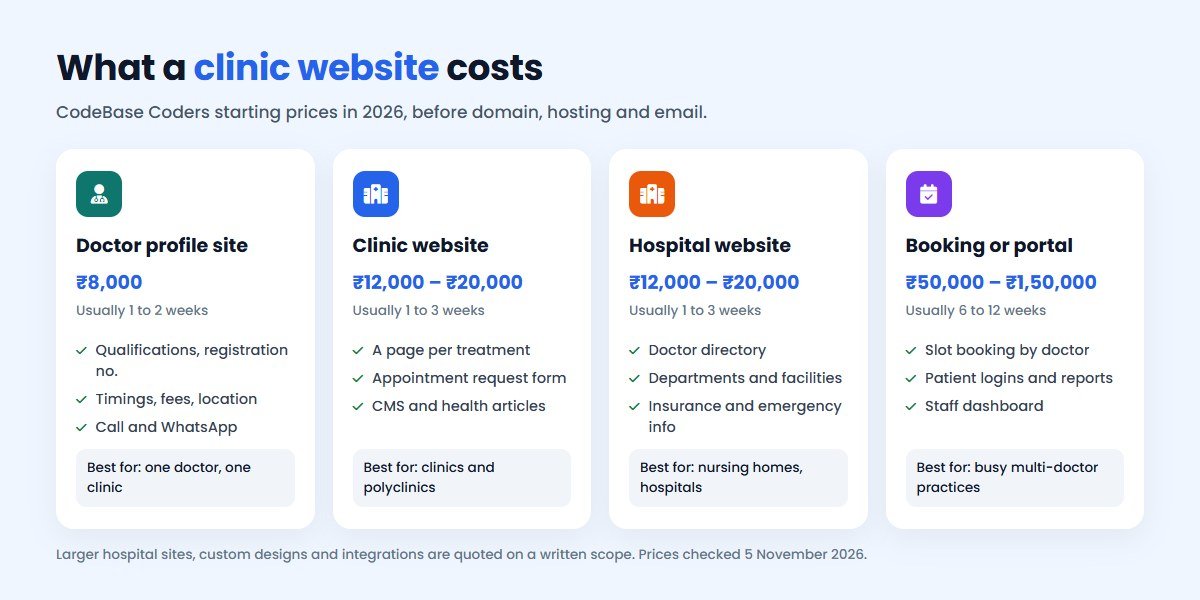
A large hospital site with many departments, a custom design or links to your hospital software costs more than these starting prices. We price that on a written scope, so you see exactly what you pay for. You can also try the cost calculator or see our packages.
Which Kind of Medical Website You Need
Doctor profile site
A short site for one doctor: name, recognised qualifications, registration number, the conditions treated, clinic address and map, OPD timings, consultation fee and a call or WhatsApp button. For many single-doctor practices, this is all a patient needs.
Clinic website
A clinic site adds a page for each treatment or service, written to inform rather than to sell, plus an appointment request form, health articles and an admin panel so your staff can update timings and notices. Our website development service covers this.
Hospital or nursing home website
Here the doctor directory matters most. The NMC guidelines say a hospital website "containing a directory of its doctors, containing the names, recognised qualifications, specialties, registration details and availability of its doctors, that serves a patient-information function" is "materially distinct from a paid or promotional advertisement". Add departments, facilities, emergency contacts, accepted insurance schemes and visiting hours.
Online booking or patient portal
When patients choose a doctor and a time slot, get reminders or download reports, the website becomes a web application. It takes longer and costs more, and it often connects to the software you run the hospital on. See web application development and hospital management software.
The New NMC Rules for Medical Websites
The NMC published its Guidelines on Ethical Advertising and Public Communication as a public notice dated 6 October 2026, in force with immediate effect. They are framed under the Indian Medical Council (Professional Conduct, Etiquette and Ethics) Regulations, 2002, which already barred doctors from soliciting patients, and they bring those rules up to date for digital media.
Three points matter most for your website:
- Websites count. The guidelines' list of advertising media includes "websites and blogs", social media, WhatsApp, online healthcare platforms and AI-generated promotion.
- You are responsible for your agency's work. Publishing through an agency, influencer or platform "shall not, by itself, absolve" the doctor or institution of responsibility for content they authorised.
- There are penalties. For doctors, the State Medical Council may act in steps, from "Warning and mandatory ethics training" for a first violation up to suspension of 6 to 12 months for serious violations such as misleading cure claims. Hospitals are dealt with under the Clinical Establishments Act or the state law that applies.
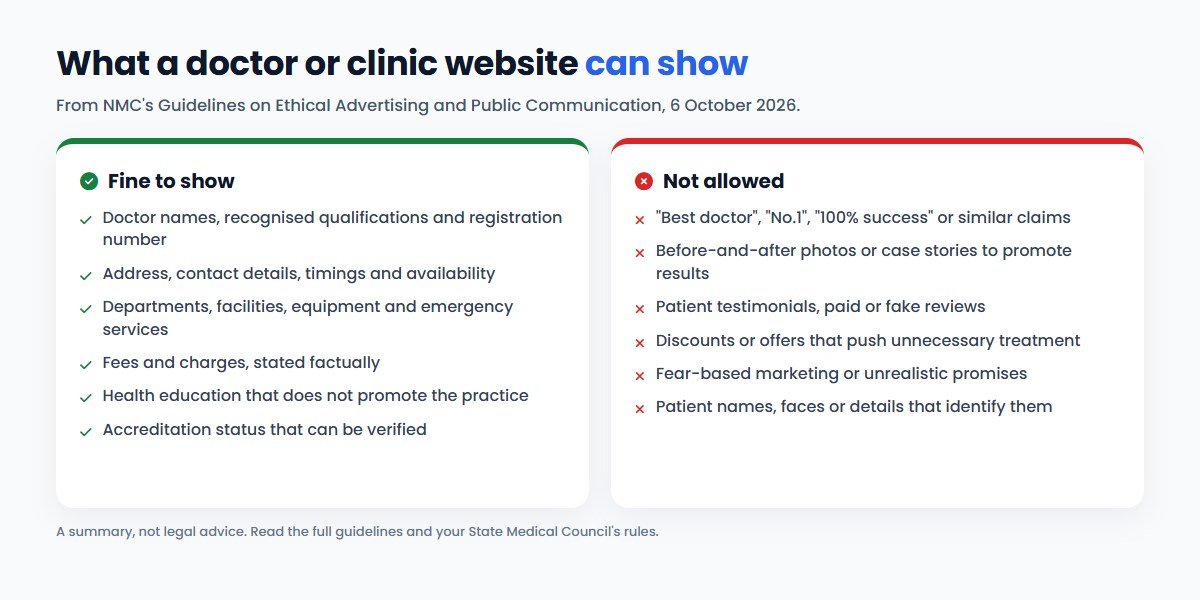
This is a plain-language summary to help you plan a website, not legal advice. Read the full guidelines and check with your State Medical Council if you are unsure about any page.
What Your Website Should Show
- Name, qualifications and registration number. The guidelines say doctors' electronic media posts "should transparently disclose their name, qualifications, registration status and SMR/NMR Registration number", and clinics should do the same for their doctors. Under the 2002 Regulations, only recognised medical degrees, and diplomas or memberships that reflect real professional qualifications, go after a doctor's name.
- Factual practice details. Address, map, phone, OPD timings, departments, facilities, equipment and emergency services. Hospitals may publish accreditation status that can be verified.
- Fees and charges. The 2002 Regulations say a physician "should announce his fees before rendering service". The new guidelines allow lawful disclosure of charges, packages or fees, provided it is "factual, transparent and not misleading".
- Health information. Plain explanations of conditions and treatments, including risks, written to inform. Pages that explain rather than persuade are both safer and more useful to patients.
- Formal announcements. Starting practice, a change of address, temporary absence or resumption of practice are permitted announcements.
What Your Website Must Leave Out
- Superlatives and success claims. The guidelines name "Guaranteed cures", "Best doctors", "No.1 Specialist", "100% success", "painless treatment" and "Miracle treatment" as examples of what not to use. Words like "leading", "most trusted" and "top" need an objectively verifiable basis.
- Before-and-after photos and promotional case stories, unless published strictly for scientific or educational purposes with anonymised patient consent. Patient consent alone does not make a testimonial or before-and-after picture acceptable.
- Testimonials and reviews used for promotion. No fake, paid or misleading reviews, ratings or testimonials, and doctors should not request or share patient testimonials or reviews to promote themselves on social media.
- Fear and pressure. No fear-based marketing, no statements that create unrealistic expectations or hide risks.
- Inducements. Discounts, limited-period offers, coupons or free procedures that are likely to encourage unnecessary consultations or tests.
- Self-promotional photographs. A doctor's photograph is not permitted where it amounts to self-advertisement or promotional publicity.
- Anything that identifies a patient. Names, faces, identification marks or other details through which a patient may be identified.
- Fake engagement. Bought followers, likes or reviews, or attempts to manipulate search rankings to look more established than you are.
- Specialist claims without the qualification. The 2002 Regulations already say a physician shall not claim to be a specialist without a special qualification in that branch.
If your current website has any of these, it is worth a review now. We offer a free website audit and can check your pages against this list.
Features That Help Patients
- Call and WhatsApp buttons on every page, because most patients look you up on a phone.
- An appointment request form that asks only for name, phone, preferred date and the doctor or department.
- A map and directions, with parking and landmark details.
- OPD timings and holidays your staff can update the same day.
- Accepted insurance schemes and cashless options, stated factually.
- Hindi as well as English where many of your patients prefer Hindi.
- Fast pages, since a slow site on mobile data loses patients before it loads.
- An honest AI assistant, if you want one. Keep it to timings, location, fees and booking, label it as AI, and never let it give medical advice. The guidelines say AI-generated promotional content must carry a mark stating that it comes from AI. Our AI website development service builds assistants limited to approved answers.
A Google Business Profile helps patients find your clinic on Maps. Keep its details factual and the same as your website.
Patient Data and Privacy
An appointment form collects personal data, and anything about health is sensitive. The guidelines say advertising that uses digital personal data must comply with the Information Technology Act, 2000 and the Digital Personal Data Protection Act, 2023 and its 2025 Rules. In practice, for a website, that means:
- Ask only for what you need to book the appointment.
- Explain in a short privacy notice what you collect and why.
- Send form data over HTTPS and keep it out of public spreadsheets and personal inboxes.
- Never put reports or prescriptions on the public website. A patient portal with logins is the right place.
- The 2002 Regulations already say a doctor shall not publish patient photographs or case reports in a way that identifies them without permission.
What You Pay Every Year After Launch
The build is a one-time cost. Running the website has a small yearly cost. Example prices we checked on 3 November 2026 from two popular providers in India (check whether tax is added at checkout):
| Item | Example price |
|---|---|
| .in domain | ₹899 a year (Hostinger) |
| Web hosting | Premium plan renews at ₹449 a month (Hostinger) |
| Business email | ₹270 per user a month (Google Workspace Business Starter) |
With a .in domain, that hosting plan and two email accounts, the total is ₹899 + ₹5,388 + ₹6,480 = ₹12,767 a year at renewal prices. Add maintenance for updates, security fixes and backups, and keep the domain, hosting and email in your own name.
A Medical Website We Have Built
Dr. Deepak Rathore is a plastic and reconstructive surgeon in Delhi NCR. His website explains 18 treatments on their own pages, from cancer reconstruction and burns to cleft lip and palate, and lets patients call or WhatsApp in one tap. See the case study.
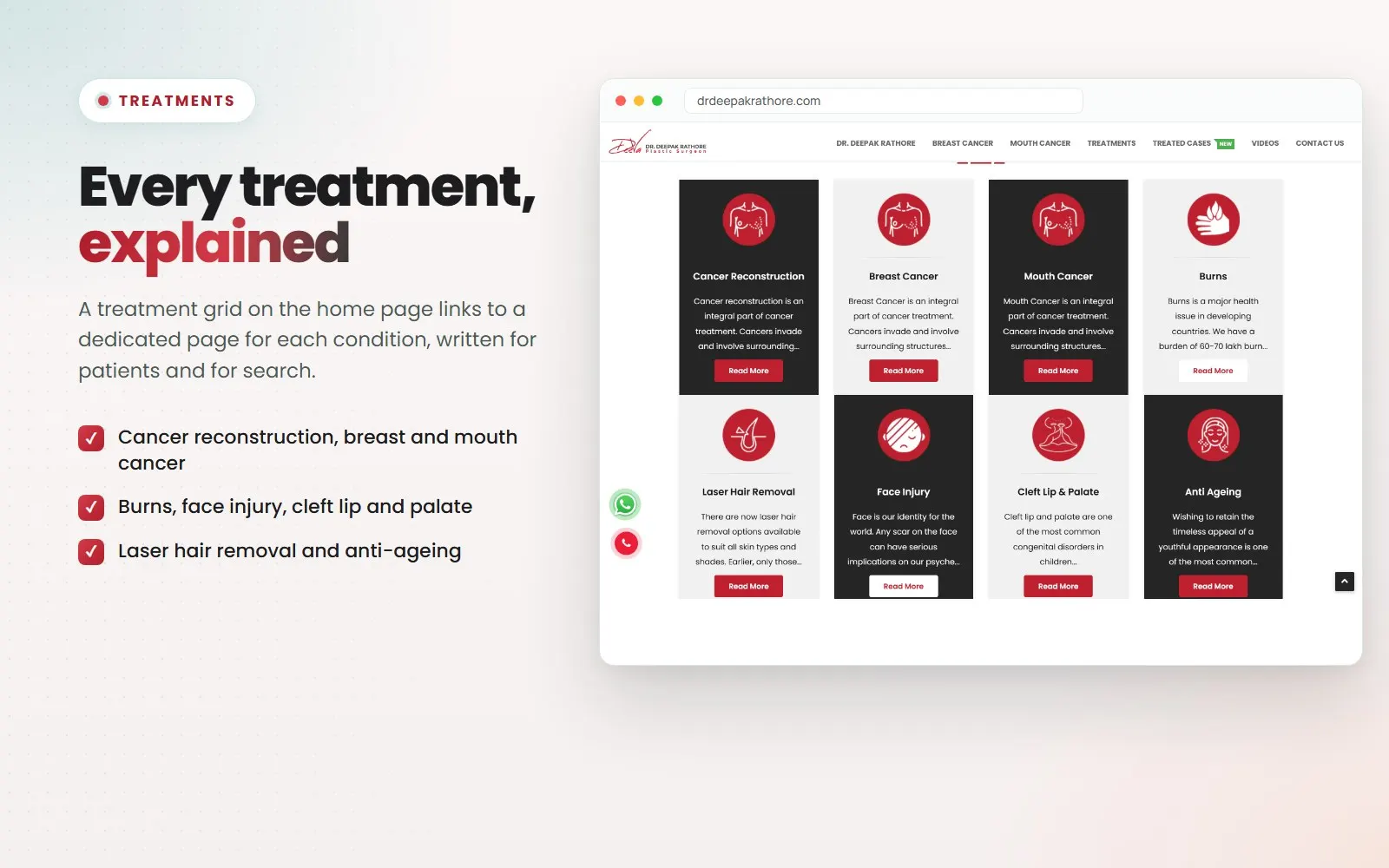
We also build hospital management software for appointments, billing and records, and website designs that look calm and clear rather than salesy. Want a price for your clinic website? Talk to us or ask for a free audit of the site you have now.
How to Get a Fair Quote
Before you ask anyone for a price, write down:
- How many doctors, departments and treatments the site will cover.
- Whether patients only request appointments or book exact slots.
- Who will update timings, notices and articles.
- The languages you need.
- Any software it must connect to, such as hospital or lab systems.
Send the same brief to everyone, and check that each quote lists pages, features, design revisions, timeline, maintenance and who owns the code and accounts. Ask how they will keep your content within the NMC guidelines, and be wary of anyone who offers "first page on Google" promises, paid reviews or before-and-after galleries. Under the guidelines, an agency also should not be paid in a way that is linked to each patient it brings in.
Conclusion
The clinic website development cost depends on how big your practice is and how patients book. With our 2026 prices, a doctor profile site starts at ₹8,000, a clinic or hospital website at ₹12,000 – ₹20,000, and an online booking or patient portal at ₹50,000 – ₹1,50,000. Add roughly ₹10,000 to ₹15,000 a year for the domain, hosting and email, plus maintenance.
Just as important, build it the way the October 2026 NMC guidelines expect: factual, verifiable and respectful of patient privacy, with names, qualifications and registration numbers in plain view. If you want our price or a review of your current site, contact us. We are based in Noida / Greater Noida, meet clients across Delhi NCR, and work online with doctors and hospitals anywhere in India.
Frequently Asked Questions
What is the clinic website development cost in India?
With CodeBase Coders, a doctor profile site starts at ₹8,000, a clinic or hospital website at ₹12,000 – ₹20,000, and an online booking or patient portal at ₹50,000 – ₹1,50,000. Larger or custom sites are priced on a written scope.
Can doctors have a website under NMC rules?
Yes. The October 2026 guidelines treat websites as a medium of advertising, so the content must be factual and verifiable. A site that shows names, qualifications, registration numbers, timings, services and fees is fine; promotional claims, testimonials and before-and-after photos are not.
Can I show patient testimonials or Google reviews on my clinic website?
The guidelines bar fake, paid or misleading reviews and testimonials, and say patient consent alone does not make a testimonial acceptable. Doctors should also not request or share patient testimonials or reviews to promote themselves on social media. Leave testimonials off the website.
Do I need to show my registration number on the website?
The guidelines say doctors should disclose their name, qualifications, registration status and SMR/NMR registration number in electronic media, and clinics should do the same for their doctors. Put it on every doctor's page.
Can I put my consultation fees on the website?
Yes, as long as they are factual, transparent and not misleading. Avoid discounts or offers that could push patients towards unnecessary consultations or tests.
How long does it take to build a clinic website?
Usually 1 to 2 weeks for a doctor profile site, 1 to 3 weeks for a clinic or hospital website, and 6 to 12 weeks for a booking portal, once we have your content.
How can CodeBase Coders help me build a clinic website?
Tell us about your practice: the doctors, departments, timings and how patients book today. We build a fast, factual website that shows what the NMC guidelines ask for, such as names, qualifications and registration numbers, and leaves out what they rule out. You get a written scope and price before you pay anything, and we can review your current website against the guidelines too. See our website development service.
Sources
- National Medical Commission: Guidelines on Ethical Advertising and Public Communication by Hospitals/Medical Institutions and Registered Medical Practitioners (public notice, 6 October 2026)
- Indian Medical Council (Professional Conduct, Etiquette and Ethics) Regulations, 2002, amended up to 8 October 2016
- Google Business Profile
- Hostinger India: domain prices (checked 3 November 2026)
- Hostinger India: web hosting prices (checked 3 November 2026)
- Google Workspace: India pricing (checked 3 November 2026)
Work With CodeBase Coders
CodeBase Coders is a software development company in Noida that builds websites, booking portals and hospital software for doctors, clinics and hospitals in Delhi NCR and across India. You own the code, design and accounts once the project is paid for.
- Website Development
- Website Design Services
- Hospital Management Software
- Web Application Development
- AI Website Development
- Packages and Starting Prices
Further reading: website development cost in Noida and real estate website development cost.
Need a clinic website? Book a free consultation and get a written scope before you pay anything, check the cost yourself, or ask for a free audit of your current website.
Rohan Verma
Founder, CodeBase CodersRohan Verma is the founder of CodeBase Coders. He helps startups, SMEs and enterprises turn ideas into scalable digital products and improve business processes through custom software, AI, automation, integrations and modern web technologies.