For the last few years, most businesses that wanted powerful AI had one realistic option: rent it. You sent your prompts and your data to a large provider's API, paid per use, and accepted whatever model, pricing and terms they offered. Open models existed, but the best ones lagged well behind.
This week that changed in a visible way. On 15 October 2026, Meta released the weights of Muse Spark Open, an 816-billion-parameter model built for coding and AI agents, describing it as the most capable US open-weights model to date. In the same week, DeepSeek published an updated V4.1 Flash under the permissive MIT license. Both can be downloaded, run on your own infrastructure and adapted to your business. Open-source AI models are no longer a hobbyist option; they are a serious choice for companies that care about data control, cost and flexibility.
This guide explains what was released, what "open" really means for these models, how open-source AI models compare with closed AI, what the licenses allow, what self-hosting actually takes, and a practical plan to decide what is right for your business, in plain language for owners and managers as well as technical teams.
At a Glance
- The news: Meta released Muse Spark Open (816B total, 42B active parameters, 1M-token context) on 15 October 2026 under its own Muse Model License. DeepSeek published V4.1 Flash-1017 (763B parameters, 1M context) under the MIT license in October 2026.
- Why it matters: businesses can now run very capable open-weight models in their own cloud or data centre, keeping data in-house and avoiding lock-in to one AI vendor.
- The catch: licenses differ, and the largest models need serious hardware. Meta's model needs about 1.5 TB of weights at full precision and multiple high-end GPU nodes.
- The practical answer: most businesses should start with a hosted open model or a smaller model, prove the use case, and only then decide whether self-hosting pays off.
The News: Two Big Open-Weight Releases in One Week
Meta Muse Spark Open
Meta's announcement on the PyTorch blog describes Muse Spark Open as an open-weights version of its Muse Spark model, released on Hugging Face under the Muse Model License. Key points:
- Size: 816 billion total parameters, with 42 billion active per token. It is a mixture-of-experts (MoE) model, which means only part of the model works on each request, making it faster and cheaper to run than its total size suggests.
- Context window: up to 1 million tokens, enough to read a large codebase or a long set of documents in one go.
- Built for coding and agents: Meta says it is trained for multi-file coding, debugging, reliable tool calling and long-running agentic tasks that plan, act and self-correct.
- Multimodal: it accepts text, images, documents and audio as input.
- Safety: the open version received additional safety training so it is more robust when run without a provider's guardrails.
- Tooling: it runs on the popular vLLM and SGLang inference engines, with optimisation for NVIDIA, AMD and Intel hardware, and can be fine-tuned with Meta's TorchTitan library (including LoRA, a lighter fine-tuning method).
Meta had earlier released Muse Glimmer, a smaller dense model, for lighter and on-device use.
DeepSeek V4.1 Flash-1017
DeepSeek's model card describes V4.1 Flash-1017 as a minor update to V4.1 Flash, with better reasoning, coding, agentic and visual results, faster task completion and shorter answers. The repository and weights are released under the MIT license, one of the most permissive licenses available. The card lists 763 billion parameters and a recommended 1-million-token context, and shows, for example, a jump on the Terminal-Bench 4.0 agentic coding benchmark from 31.2 to 42.3 compared with the previous version.
One caution applies to both: benchmark figures in launch materials come from the model makers. At the time of writing, reporting notes that Meta's results had not yet been independently ranked. Always test models on your own tasks before relying on them.
What Are Open-Source AI Models?
Open-source AI models are AI models whose trained weights, the numbers that make the model work, are published so anyone can download, run and modify them. Strictly speaking, most of today's releases are open-weight models: you get the weights and usage rights, but not always the training data or full training code, and the license may add conditions. In everyday business conversation, both are called open-source AI or open source LLMs (large language models).
The practical difference from a closed model is simple:
- With a closed model, the model stays on the provider's servers. You can only use it through their API, on their terms.
- With an open model, you can run it wherever you choose: through any hosting provider, in your own cloud account, or on your own servers, and you can fine-tune it on your data.
Open-Source vs Closed AI Models
| Factor | Open-source / open-weight models | Closed models (API only) |
|---|---|---|
| Data control | Can run fully inside your cloud or network | Data is processed by the provider |
| Customisation | Full fine-tuning and modification possible | Limited to what the provider offers |
| Vendor lock-in | Low: switch hosts or models freely | Higher: tied to one provider's models and pricing |
| Cost model | Infrastructure and engineering; cheaper at high, steady volume | Pay per use; cheaper at low or unpredictable volume |
| Setup effort | Higher: hosting, scaling, monitoring and updates are on you | Low: call an API and start |
| Peak capability | Closing the gap; strong for coding and agents | Often still leads on the hardest tasks |
| Licensing | Varies: from MIT to custom licenses with conditions | Provider's terms of service |
Neither is better in every case. Many businesses end up using both: a closed model for the hardest reasoning tasks and an open model for high-volume or sensitive work.
Why Businesses Are Looking at Open Models
1. Data privacy and compliance
Customer records, contracts, health data and financial information are exactly what businesses want AI to work with, and exactly what they are nervous about sending to a third party. A self-hosted LLM or private LLM keeps that data inside your environment. For Indian businesses, this can simplify obligations under the Digital Personal Data Protection (DPDP) Act; our DPDP Act compliance checklist covers what applies to apps and websites.
2. Cost predictability at scale
Per-token API pricing is ideal when usage is small or unpredictable. When an AI feature handles thousands of requests a day, every day, the bill can grow fast. Running an open model on dedicated infrastructure turns a variable cost into a more predictable one, though only once volume is high enough to keep the hardware busy.
3. No lock-in
Model leadership changes month to month. If your product is built around an open model and a standard inference engine, you can swap in a newer or cheaper model without rewriting your application or renegotiating with one vendor.
4. Customisation
LLM fine-tuning on your own documents, tone and workflows can make a model noticeably better at your specific tasks, such as classifying support tickets, drafting replies in your brand voice or understanding your product catalogue.
5. Agents and coding
Both new releases focus on coding and agentic work: models that plan steps, call tools and complete multi-step tasks. That makes them relevant for internal developer tools and for AI agents that work across your systems.
Read the License Before You Build
"Open" does not always mean "do anything you like". The two new models show the range:
- DeepSeek V4.1 Flash (MIT): very permissive. You can use, modify and build commercial products with it, with minimal conditions such as keeping the license notice.
- Meta Muse Spark Open (Muse Model License): free to use, fine-tune and build into your own products, but with conditions reported at launch: products must show "Built with Muse Spark Open"; companies offering the model itself as an AI service with more than US$20 million in revenue over 12 months need a separate agreement with Meta; and an acceptable-use policy rules out uses such as weapons, malware and fraud.
For most startups and SMEs building the model into their own product or internal tools, these conditions are manageable. But check three things before you commit: attribution requirements, revenue or usage thresholds, and any restricted use cases that touch your industry. If AI governance is new to your business, our AI governance consulting can help set the rules.
What It Takes to Self-Host a Large Model
This is where expectations need care. The largest open-source AI models are big:
- According to Hugging Face, Muse Spark Open's full-precision (BF16) checkpoint is about 1.5 TB and needs four nodes of eight NVIDIA H200 GPUs. A compressed NVFP4 version runs on a single NVIDIA B200 node.
- Quantised versions, which reduce precision to save memory, make smaller setups possible: Hugging Face reports a 2-bit version using about 304 GB of memory on a 512 GB Apple M3 Ultra workstation. Lower precision can reduce quality, so test it.
- DeepSeek's 763B model likewise needs multi-GPU server hardware and is served with engines such as vLLM or SGLang.
In other words, running the very largest model on your own hardware is a data-centre project, not a laptop project. The good news is that you rarely need the largest model. Smaller open models handle many business tasks well, such as summarising, classifying, extracting data from documents and answering questions over your knowledge base, at a fraction of the hardware cost. The right approach is to match model size to the task.
Three Ways to Use Open-Source AI Models
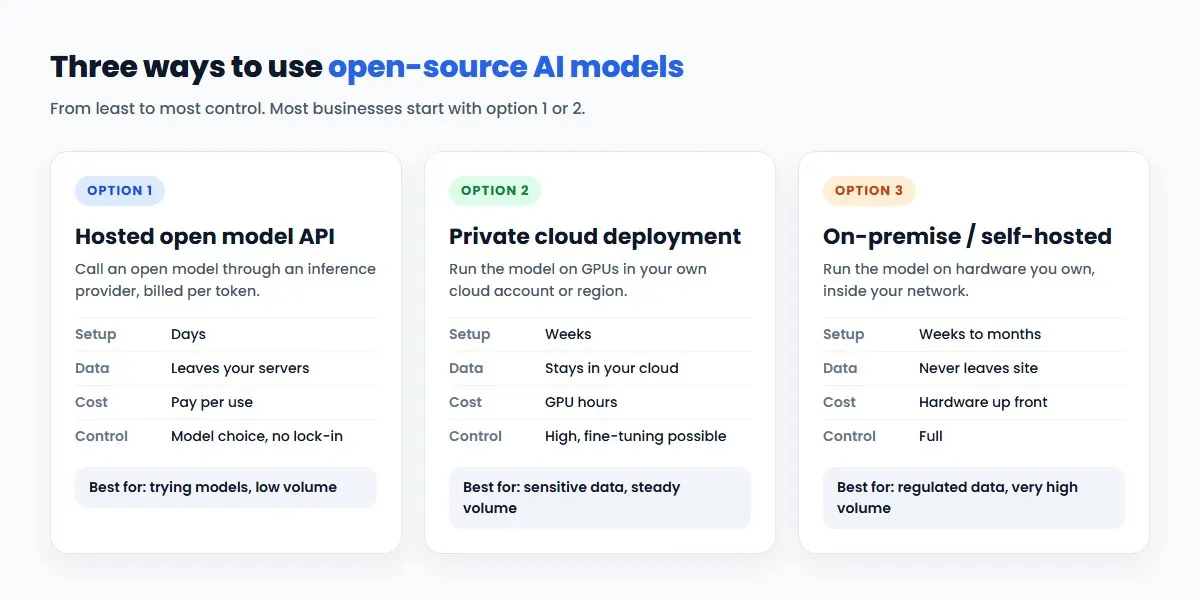
Option 1: Hosted open model API
Use an inference provider that already runs the open model and pay per token, just like a closed API. This is the fastest way to test open-source AI models and avoids lock-in, but your data still goes to a third party.
Option 2: Private cloud deployment
Run the model on GPU instances in your own AWS, Azure or Google Cloud account, in the region you choose. Data stays in your cloud, you can fine-tune, and you pay for GPU hours. This is the most common route for businesses with sensitive data and steady usage.
Option 3: On-premise self-hosting
Run the model on hardware you own inside your network. This gives full control and suits regulated data or very high, constant volume, but needs upfront hardware investment and in-house or partner expertise to operate.
How to Choose: A 6-Step Decision Plan
- Define the job. Write down the exact task (for example, "answer customer questions from our policy documents" or "review pull requests") and what a good answer looks like.
- Classify the data. Decide what data the AI will see and whether it may leave your environment. Personal, financial or health data often points towards private deployment.
- Estimate volume. Roughly how many requests per day, and how long are they? Low or spiky volume favours APIs; high, steady volume can justify your own infrastructure.
- Test two or three models on your own data. Compare an open model, a smaller open model and a closed model on 50 to 100 real examples. Benchmarks are a starting point, not a decision.
- Check the license and total cost. Include GPUs or hosting, engineering time, monitoring and updates, not just the per-token price.
- Start small, then scale. Launch one use case through a hosted API or a small private deployment, measure results, and move to dedicated infrastructure only when the numbers justify it. Our guide to AI integration and ROI covers how to measure this.
Use Cases for Startups and SMEs
- Private knowledge assistant: an internal chatbot that answers staff questions from your documents, SOPs and policies, without those documents leaving your cloud.
- Customer support automation: drafting replies, classifying tickets and answering common questions on your website or WhatsApp. See our guide to AI customer service.
- Document processing: extracting data from invoices, contracts, forms and KYC documents into your CRM or ERP.
- Coding assistants: code review, test generation and documentation for your development team, running on your own infrastructure so source code stays private.
- AI features inside your product: SaaS companies can embed an open model to add AI features without paying a per-user API margin forever. Our SaaS development guide explains how to plan this.
For a sense of budgets, our AI chatbot development cost guide breaks down typical cost ranges and the factors that drive them.
Risks to Plan For
- Operations: with self-hosting, uptime, scaling, security patches and model updates become your responsibility.
- Quality gaps: an open model may be strong at coding and weaker at your specific language, domain or task. Test before committing.
- Safety and misuse: without a provider's guardrails, you need your own content filters, access controls and logging.
- License changes: custom licenses can change between versions. Pin the version you use and review terms on upgrade.
- Hidden costs: idle GPUs cost money. Underused infrastructure can be more expensive than an API.
Conclusion
The releases of Meta Muse Spark Open and DeepSeek V4.1 Flash in October 2026 mark a turning point: open-source AI models are now capable enough for serious coding, agentic and business work, and they give companies something closed APIs cannot, which is control over where their data goes, what the model does and what it costs over time.
That does not mean every business should rush to buy GPUs. The smart path is to start with a clear use case, test open and closed models on your own data, read the license, and choose the deployment option that fits your data sensitivity and volume. For many businesses, the answer will be a mix: closed models where they lead, and open models where privacy, cost or customisation matter most.
Frequently Asked Questions
What are open-source AI models?
Open-source AI models are AI models whose trained weights are published so anyone can download, run and modify them, subject to their license. Most current releases are open-weight models, which share the weights but not always the training data.
What is Meta Muse Spark Open?
Muse Spark Open is an open-weight AI model released by Meta on 15 October 2026. It has 816 billion total and 42 billion active parameters, a 1-million-token context window, and is built for coding and AI agents. It is available on Hugging Face under the Muse Model License.
Is DeepSeek V4.1 Flash free for commercial use?
DeepSeek's model card states that the V4.1 Flash-1017 repository and weights are licensed under the MIT license, which permits commercial use. Running the model still has infrastructure costs, and DeepSeek's own API is billed separately.
Can a small business self-host an LLM?
Yes, but usually not the largest models. Smaller open models can run on a single GPU server or a cloud GPU instance and handle many business tasks. Most small businesses start with a hosted open model or a private cloud deployment rather than buying hardware.
Are open-source AI models secure?
They can be more private, because data stays in your environment, but security depends on how you deploy them. You are responsible for access control, logging, content filtering and keeping the software updated.
How can CodeBase Coders help with open-source AI models?
CodeBase Coders helps you choose between open and closed models, test them on your own data, and deploy the right one: through a hosted API, in your private cloud or on your own servers. We build the retrieval, fine-tuning, integrations and monitoring around the model so it works inside your CRM, help desk or product. Explore our AI development services, AI consulting, AI integration services and AI governance consulting, or book a free consultation.
Sources
- PyTorch blog (15 October 2026): Muse Spark Is Now an Open-Weights Model
- Hugging Face (15 October 2026): Welcome Muse Spark Open (specifications and hardware requirements)
- Trending Topics (15 October 2026): Meta's Muse Spark Open comes with strings attached (license terms)
- Hugging Face: DeepSeek-V4.1-Flash-1017 model card (MIT license, specifications and benchmarks)
Work With CodeBase Coders
CodeBase Coders helps businesses turn ideas into scalable digital products and improve existing processes through software, automation, AI, integrations and modern web technologies. For open-source AI, we help you pick and test the right model, deploy it through an API, your private cloud or your own servers, connect it to your data and systems, and keep it secure, governed and measured.
- AI Development Services
- AI Consulting
- AI Integration Services
- AI Agent Development
- AI Product Engineering
- AI Governance Consulting
- Dedicated Development Team
Thinking about a private or self-hosted AI model? Book a free consultation with CodeBase Coders and we will help you compare open and closed models on your own data and choose the right deployment.
Rohan Verma
Founder, CodeBase CodersRohan Verma is the founder of CodeBase Coders. He helps startups, SMEs and enterprises turn ideas into scalable digital products and improve business processes through custom software, AI, automation, integrations and modern web technologies.