You have a website, app or software project, a budget and a deadline. The next question decides more about its success than any technology choice: who builds it? Most business owners weigh three options. They can hire a freelancer, hire a software development company, or build an in-house team. Searching "freelancer vs software development company" usually means you are close to making that call, and want to avoid paying twice.
Each option is the right answer for some projects and an expensive mistake for others. This guide compares them on what actually matters: total cost, speed, risk, who owns the code under Indian law, and how much of your own time each one needs. It ends with a checklist you can use before you sign anything.
To be transparent: CodeBase Coders is a software development company, so we have a view. We have tried to be fair, and the sections on when to choose a freelancer or an in-house team are written to be used, not to steer you to us.
The Quick Answer
- Hire a freelancer for small, well-defined tasks that one person can finish and you can check yourself: a landing page, a WordPress fix, a single integration, a design.
- Hire a software development company when you need a complete product or system, such as an MVP, a web or mobile app, a CRM or an AI integration, delivered on a deadline with design, development, testing and launch handled by one accountable team.
- Build an in-house team when software is your core business, the work will never stop, and you are ready to recruit and lead engineers.
Many businesses combine them: a company builds version one, a small in-house team takes over the core, and freelancers handle extras.
The Three Options in Plain Words
Freelancer
An independent developer or designer you hire directly, through referrals, LinkedIn or a freelance marketplace. You pay by the hour, by milestone or for a fixed scope. You get one person's skills and availability, and you manage the work.
Software development company
A firm with a team of developers, designers, testers, DevOps engineers and project managers. It takes responsibility for delivering an agreed scope, or provides a dedicated team that works as an extension of yours. Engagements are usually a fixed-price project, time and materials, or a monthly dedicated team.
In-house team
Developers on your own payroll, working only on your product. You recruit them, pay salaries and benefits, provide equipment and tools, and lead the work, usually through a CTO or senior engineer.
Side by Side: Freelancer vs Company vs In-House
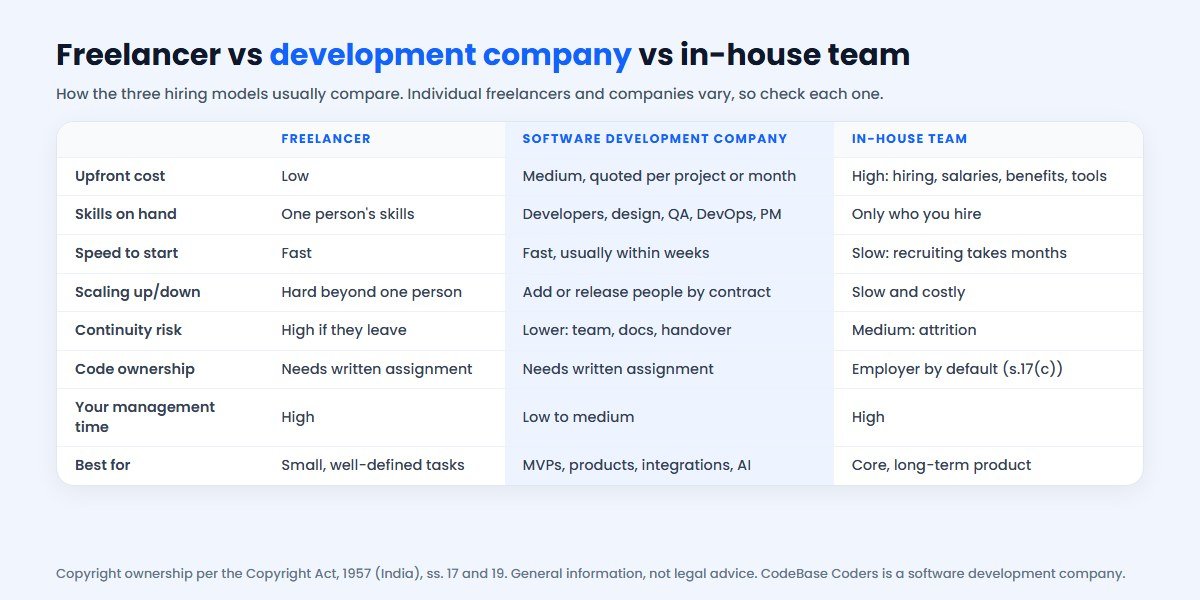
| Factor | Freelancer | Software development company | In-house team |
|---|---|---|---|
| Best for | Small, defined tasks | Complete products, MVPs, integrations, AI | Core, long-term products |
| Skills | One person's | A full team: development, design, QA, DevOps, PM | Whoever you manage to hire |
| Upfront cost | Lowest | Medium, quoted per project or month | Highest: recruiting, salaries, benefits, tools |
| Time to start | Days | Usually days to a few weeks | Often months to recruit |
| Scaling | Limited to one person | Add or release people by contract | Slow and costly either way |
| Continuity | At risk if they leave or get busy | Team, documentation and handover | At risk from attrition |
| Code ownership (India) | Needs a written assignment | Needs a written assignment | Employer owns by default |
| Your management time | High | Low to medium | High |
| Accountability | One individual | A company with a contract | You |
The Real Cost of Each Option
Comparing hourly rates is the most common mistake. The rate is only one line of the real cost. Compare what you will pay to get working, tested, maintained software, including your own time.
Freelancer: lowest rate, hidden extras
- The quote usually covers development only. Design, testing, server setup, security and project management are often extra, or left to you.
- Marketplace service fees can apply on top of the freelancer's price if you hire through a platform. Check the platform's current fee page before you budget.
- Your time: writing requirements, reviewing work, testing and chasing updates.
- Rework: if the code has to be rewritten later, you pay twice.
Software development company: higher rate, more included
- A quote normally covers a team: project management, UI/UX design, development, quality assurance and deployment.
- Fixed-price projects move the risk of overruns to the company, if the scope is clear. Time-and-materials or dedicated teams give flexibility when scope will change.
- Ask what is excluded: third-party licences, hosting, app store fees and post-launch support are often separate.
In-house team: highest fixed cost
- Salaries are only the start. In India, employers also pay costs such as their Employees' Provident Fund contribution, typically 12% of basic wages, plus other benefits.
- Recruitment fees or time, laptops, software licences, cloud accounts, office space and training.
- Management: someone senior must lead, review code and set technical direction.
- Idle cost: you pay salaries even in months with less work.
For a realistic number for your own project, try our software cost calculator or the guides on web app development cost and mobile app development cost in India.
Speed: How Fast Can Each Start and Deliver?
Starting: a freelancer can often start within days. A development company can usually start within days or a few weeks, after a short discovery to agree scope. An in-house team is slowest: finding, interviewing and onboarding good developers commonly takes months.
Delivering: here the order changes. One freelancer works on one thing at a time, so a project that needs design, backend, frontend, mobile and testing is done in sequence. A company can run those in parallel with several specialists, which is why it often ships a complete product sooner, even if it costs more per hour.
Risk: What Happens When Something Goes Wrong
- Someone leaves. If your only freelancer takes a full-time job or another client, the project stops and the knowledge goes with them. A company can replace a team member and keep going. An in-house team loses knowledge whenever someone resigns.
- Quality problems. Without code review and testing, bugs and security gaps reach your customers. Companies usually have QA built into their process; with a freelancer you need to arrange it.
- Scope creep and missed deadlines. Clear milestones and written acceptance criteria protect you with any option. A fixed-price contract with a company shifts some of the overrun risk away from you.
- Security and data protection. If the software handles personal data, India's Digital Personal Data Protection Act makes you responsible for how it is processed. Make sure whoever builds it follows secure practices and signs a contract that covers data handling.
- Lock-in. If only one person understands the code, you depend on them. Ask for documentation, access to the repository from day one, and handover support in writing.
Already stuck with half-finished or fragile code from an earlier vendor? Our free audit reviews it and tells you whether to fix or rebuild.
Who Owns the Code? What Indian Law Says
This is the question most buyers forget to ask, and the answer differs by option. Under India's Copyright Act, 1957:
- In-house employees: section 17(c) makes the employer the first owner of copyright in work an employee creates in the course of employment under a contract of service, unless there is an agreement to the contrary. Your employment contracts should still say so clearly.
- Freelancers and development companies: they work under a contract for service, not of service, so the default rule for employees does not apply. To own the code you need a written assignment.
- Write the assignment properly. Section 19 requires an assignment to be in writing and signed, and to identify the work, the rights assigned, the duration and the territory. If the duration is not stated it is treated as five years, and if the territory is not stated it is presumed to be India only. The Delhi High Court applied exactly these defaults in Pine Labs v. Gemalto Terminals India, where an assignment that was silent on duration lapsed after five years.
Practical rule: whoever builds your software, get a signed agreement that assigns all rights in the code, designs and documentation to you, worldwide and for the full term of copyright, once you have paid. Also make sure you control the source code repository, domain, hosting, app store and cloud accounts. This is general information, not legal advice; have a lawyer review important contracts.
At CodeBase Coders, code, designs and accounts are yours once the project is paid for, and we sign an NDA before you share details.
When a Freelancer Is the Right Choice
- The work is small, clear and fits one skill set, such as a WordPress change, a landing page, a Shopify theme tweak or a design.
- It will take days or a few weeks, not months.
- You or someone on your team can review the work technically.
- A delay would be inconvenient but not costly.
- Budget is tight and you accept more of the management and risk yourself.
A good freelancer can be excellent value. The problems start when a freelancer is asked to be a whole team.
When a Software Development Company Is the Right Choice
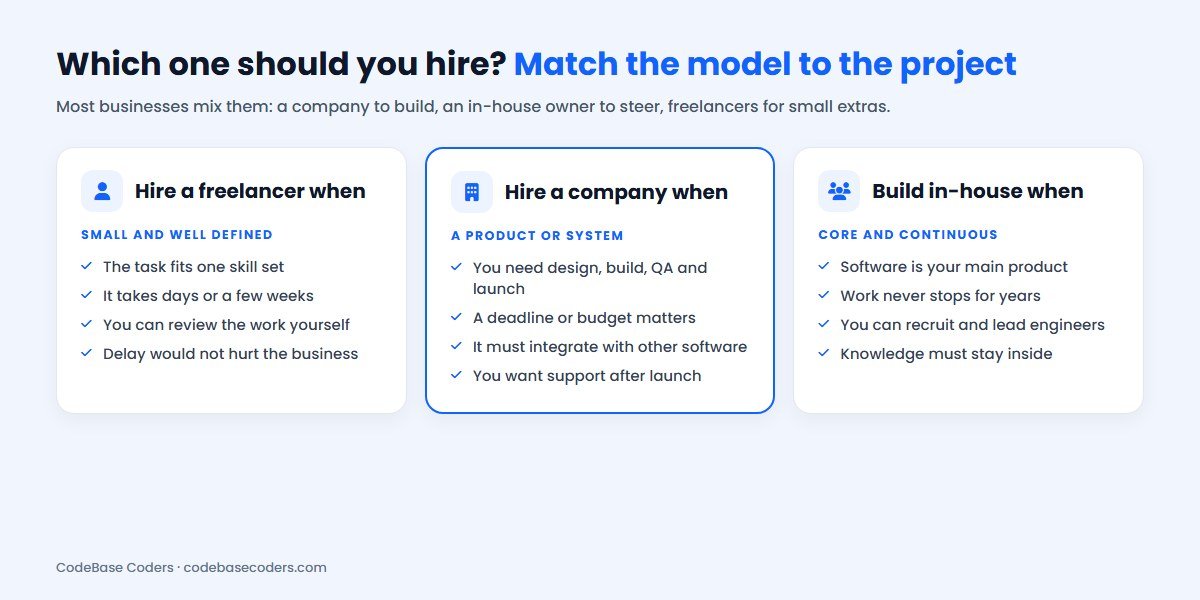
- You are building a product or system: an MVP or SaaS product, a web application, a mobile app, a custom CRM or an AI integration.
- It needs several skills: UX design, backend, frontend, mobile, testing, cloud and security.
- A deadline, launch or investor milestone depends on it.
- It must connect to other systems: payment gateways, ERPs, WhatsApp, CRMs or third-party APIs.
- You want one contract, one accountable partner and support after launch.
- You do not have a technical leader in-house and need guidance on architecture and technology choices.
Not ready for a full project? A company can also supply a dedicated team or individual specialists, such as Laravel, React or Node.js developers, who work under your direction without you having to recruit them.
When to Build an In-House Team
- Software is your product and your main source of competitive advantage.
- Development will continue for years without breaks.
- You have, or can hire, a technical leader to recruit and manage engineers.
- Deep domain knowledge must stay inside the company.
- You can carry the fixed cost through slower months.
Even then, many companies use an outside team to launch first, prove the product and then hire in-house with a working codebase and clear requirements.
The Hybrid Model Most Businesses End Up With
In practice the best setup often combines all three:
- A development company builds and launches version one quickly, with a full team.
- One in-house product owner or technical lead steers priorities and owns the relationship with customers.
- The company stays on for maintenance, new features or a dedicated team, or hands over to an in-house team with documentation.
- Freelancers handle small, separate pieces such as illustrations, content or one-off fixes.
This gives you speed at the start, control over direction, and flexibility on cost.
How to Vet a Freelancer or a Development Company
- Look at similar work. Ask for live projects or case studies close to yours, and try them.
- Talk to the people who will do the work, not only sales. Ask how they would approach your project.
- Ask for an itemised estimate with features, milestones, timeline and what is excluded.
- Check the process: how requirements are agreed, how often you see progress, how testing and code review work.
- Agree ownership and access in writing: code assignment, repository access from day one, and who holds the accounts.
- Ask about after launch: bug-fix warranty, maintenance and support options and their cost.
- Start small if unsure: a paid discovery phase or first milestone shows how they work before you commit to everything.
Red Flags in Any Proposal
- A price far below everyone else's with no explanation of what is excluded.
- No written scope, milestones or acceptance criteria.
- Reluctance to give you repository access or to assign ownership of the code.
- No mention of testing, security or documentation.
- Promises of specific rankings, revenue or results that nobody can control.
- Large payments demanded up front before any work is delivered.
- You never speak to the people who will actually build it.
A Decision Checklist
- Is this a small task or a complete product?
- How many different skills does it need?
- What happens to your business if it is late or the builder disappears?
- Who on your side can review technical work?
- Will development continue for years, or is this a defined project?
- What is your total budget, including your own time, testing and maintenance?
- Have you agreed code ownership, repository access and account control in writing?
If you answered "complete product", "several skills" and "a delay would hurt", a software development company is usually the safest choice.
Conclusion
The freelancer vs software development company decision, with in-house as the third option, is really about matching the builder to the job. Freelancers are great value for small, clear tasks. A software development company gives you a full, accountable team for products and systems where speed, quality and support matter. An in-house team makes sense when software is your core business for the long run. Whichever you choose, budget for the total cost, insist on milestones and testing, and get a written assignment of the code so your software is truly yours.
Frequently Asked Questions
Is it cheaper to hire a freelancer or a software development company?
A freelancer's rate is usually lower. But a company's quote often includes design, testing, project management and deployment that you would otherwise arrange yourself, so compare the total cost of working, tested software, not hourly rates.
Should a startup hire a freelancer or an agency for its MVP?
If the MVP is small and you can manage it technically, a strong freelancer can work. If it needs design, backend, mobile and testing on a deadline, or you have no technical co-founder, a development company is usually less risky.
Who owns the code if I hire a freelancer in India?
Under the Copyright Act, 1957, the default rule that makes an employer the owner applies to employees, not freelancers. To own the code you need a written, signed assignment that states the rights, duration and territory; otherwise it may be limited to five years and India.
Is outsourcing software development better than hiring in-house?
Outsourcing is faster to start and easier to scale up or down; in-house gives more control and keeps knowledge inside. Many businesses outsource the first version and build in-house once the product is proven.
What is a dedicated development team?
A team of developers from a software company that works only on your project, usually on a monthly basis and under your direction. It gives you in-house-like focus without recruiting and employing people yourself.
How can CodeBase Coders help me decide between a freelancer, a company and an in-house team?
Tell us what you want to build and we will give you a free consultation and an itemised estimate, and tell you honestly if a freelancer or an in-house hire would serve you better. If we are the right fit, we can take the whole project as a software development partner, provide a dedicated development team, or work alongside your own developers. Code, designs and accounts are yours once the project is paid for, and we sign an NDA before you share details. Book a free consultation.
Sources
- The Copyright Act, 1957: Section 17 (first owner of copyright)
- Assignment of copyright in software under the Indian Copyright Act (Section 19; Pine Labs v. Gemalto)
- Employees' Provident Fund Organisation (EPFO)
- MeitY: Digital Personal Data Protection framework
Work With CodeBase Coders
CodeBase Coders helps businesses turn ideas into scalable digital products and improve existing processes through software, automation, AI, integrations and modern web technologies. Every project starts with a free consultation and an itemised estimate, and the code, designs and accounts are yours once the project is paid for.
- Custom Software Development
- Web Application Development
- Mobile App Development
- AI Product & MVP Engineering
- Dedicated Development Team
- Hire Developers
- ConverseIQ WhatsApp Marketing Software
Deciding who should build your project? Get a free consultation and estimate. We will tell you honestly whether you need a company, a freelancer or your own team.
Rohan Verma
Founder, CodeBase CodersRohan Verma is the founder of CodeBase Coders. He helps startups, SMEs and enterprises turn ideas into scalable digital products and improve business processes through custom software, AI, automation, integrations and modern web technologies.