Since January 2020, accepting a UPI payment has cost Indian businesses nothing. That is about to change. In September 2026 the National Payments Corporation of India (NPCI) announced UPI charges for merchants: a 0.4% merchant discount rate (MDR) on many UPI payments above ₹2,000. The fee was due to start on 15 October. Two days before that, after pushback from retailers and petrol pump operators, NPCI postponed it until after Diwali without naming a new date.
The pause gives you time to prepare, but the plan has not been withdrawn. If your shop, clinic, online store, app or SaaS product takes larger payments through UPI, you need to know what you will pay, which payments are exempt and what to change in your pricing, checkout and accounts. This guide explains the new UPI MDR in plain language, works through real numbers and gives you a practical checklist for when the charge takes effect.
At a Glance
- The charge: 0.4% MDR on person-to-merchant (P2M) UPI payments above ₹2,000, capped at ₹300 per transaction for payments of ₹75,000 or more.
- Status: announced by NPCI in September 2026 for 15 October, then postponed on 13 October until after Diwali. No new date had been announced at the time of writing.
- Still free: payments of ₹2,000 or less, all person-to-person (P2P) transfers and small merchants receiving up to ₹1 lakh a month through UPI.
- Special rates: a flat ₹5 for railways, telecom, insurance and fuel; 0.02% (capped at ₹300) for capital-market payments.
- Outside the framework: recurring UPI AutoPay mandates and credit-linked UPI such as RuPay credit cards.
- Customers: pay nothing extra. Merchants are not allowed to pass the MDR on.
- Why it matters: UPI stays cheaper than cards, but businesses with high-value UPI sales will see a real cost for the first time in more than six years.
The News: A UPI Merchant Fee, Then a Pause
UPI is the backbone of Indian payments. According to NPCI figures reported by TechCrunch, it processed 24.51 billion transactions worth ₹29.9 trillion in August 2026 and 24.07 billion transactions worth ₹29.37 trillion in September. Since January 2020, the government has kept UPI free for merchants and subsidised banks and payment companies for some of the processing cost.
Banks and payment providers have long argued that this model cannot last at UPI's scale. NPCI cites an industry estimate that running the network costs around ₹200 billion a year. In August 2026, the government amended India's payments law to allow merchant fees on some UPI transactions. On 15 September 2026, NPCI announced the new merchant discount rate and published FAQs explaining it, with a start date of 15 October.
The reaction was immediate. Retailers and petrol pump operators opposed the fee, and some petrol pump operators warned they might stop accepting UPI if it took effect. On 13 October 2026, NPCI postponed the rollout until after Diwali, citing the festive shopping season. It did not announce a new date. As commentators have pointed out, a postponement is not the same as a withdrawal: the framework announced in September still stands.
NPCI says the money collected will be shared among participants in the UPI ecosystem and used for infrastructure, cybersecurity, fraud prevention and customer service. Part of it is meant to fund a programme that brings digital payments to smaller towns and rural areas. The details of that fund are to be finalised with the Reserve Bank of India (RBI).
What Are UPI Charges for Merchants?
The new UPI charges for merchants are a merchant discount rate (MDR). MDR is the fee a business pays to the banks and payment companies that process a digital payment. It is the same idea as the fee you pay when a customer swipes a credit or debit card.
A few points are often misunderstood:
- It is a merchant charge, not a consumer charge. Customers scanning a QR code or paying in an app pay nothing extra, whatever the amount.
- It is not a tax. NPCI's FAQs say the MDR is not a tax or fee collected by the government. It goes to the payment ecosystem.
- It only applies to merchant payments. Sending money to friends and family (P2P) stays free at any value.
- It is charged per transaction, on the full amount. NPCI's examples show a ₹3,000 payment attracting ₹12, which is 0.4% of the whole ₹3,000, not just the part above ₹2,000.
- Nothing changes for your QR code. Existing UPI QR codes keep working; you do not need new ones.
UPI Charges Above ₹2,000: The Full Rate Card
Here is how UPI charges above ₹2,000 are structured under the framework NPCI announced in September 2026:
| Payment type | Charge to the merchant |
|---|---|
| P2M payment of ₹2,000 or less | Free |
| P2M payment above ₹2,000 (standard) | 0.4% of the payment |
| P2M payment of ₹75,000 or more | Capped at ₹300 per transaction |
| Railways, telecom, insurance, fuel (above ₹2,000) | Flat ₹5 per transaction |
| Capital markets: mutual funds, securities, brokers | 0.02%, capped at ₹300 |
| Educational institutions (above ₹2,000) | Concessional or capped MDR |
| Small merchants up to ₹1 lakh a month through UPI | Free |
| Person-to-person (P2P) transfers | Free at any value |
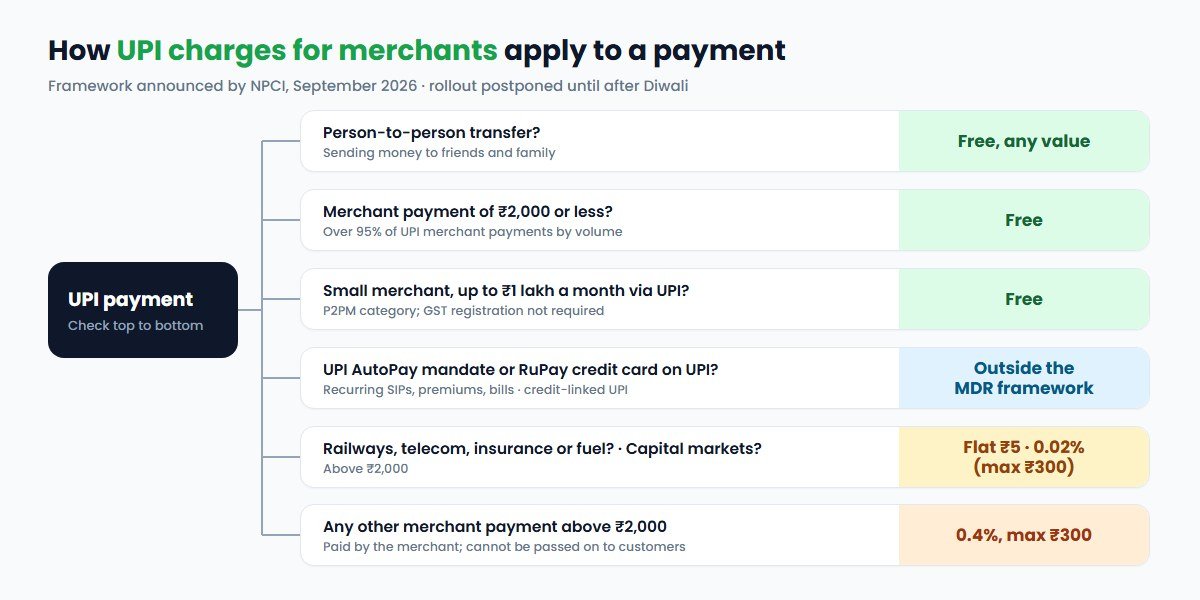
NPCI says operational details, such as how fees are shared and category-wise caps, will be decided by its UPI and Services Steering Committee. Some details may change before the new start date, so check NPCI's official announcements before you finalise prices or contracts.
Who Pays, and Who Is Exempt
Who pays the UPI MDR
The MDR is paid by the merchant receiving the payment. According to NPCI's FAQs, merchants may not pass it on to customers as a surcharge, and UPI apps may not add their own platform fees to UPI transactions. NPCI's view is that 0.4% is low enough for businesses to absorb.
The small merchant exemption
Small merchants who receive up to ₹1 lakh a month through UPI are exempt and pay zero MDR. NPCI's FAQs describe these as merchants in the P2PM (person-to-person merchant) category collecting through UPI QR codes, and say GST registration is not needed to qualify. Exactly how your business is categorised depends on how your bank or payment provider onboarded you, so ask them which category you are in.
UPI AutoPay and recurring payments
NPCI's September clarification excluded recurring UPI AutoPay mandates from the MDR framework. That covers payments such as mutual fund SIPs, insurance premiums, utility bills and other eligible automated mandates. For subscription businesses, this is an important detail, and it is covered further below.
RuPay credit cards on UPI
Payments made through credit-linked UPI, such as RuPay credit cards linked to UPI and pre-sanctioned bank credit lines, are not covered by the new framework. They stay under existing credit rules, which already allow merchant charges.
Who is most affected
NPCI says payments of up to ₹2,000 make up more than 95% of UPI merchant transactions by volume, so most everyday payments at grocery stores, cafés and small shops will stay free. The businesses that feel the change are those whose customers regularly pay larger amounts by UPI: electronics and appliance stores, furniture and home décor, jewellers, travel agents, healthcare and diagnostic centres, coaching institutes, B2B suppliers, real-estate services and online stores with higher order values.
What the New UPI Charges Will Cost Your Business
The maths is simple: 0.4% of each eligible payment, with a ₹300 ceiling per payment. Here is what that looks like at different amounts:
| UPI payment | MDR at 0.4% |
|---|---|
| ₹1,500 | ₹0 (at or below ₹2,000) |
| ₹3,000 | ₹12 |
| ₹10,000 | ₹40 |
| ₹50,000 | ₹200 |
| ₹75,000 | ₹300 (cap reached) |
| ₹2,00,000 | ₹300 (capped) |
To estimate your own monthly cost, you need three numbers from your payment data:
- Your monthly UPI collections, to check whether you fall under the small merchant exemption.
- The share of UPI payments above ₹2,000, by count and by value.
- How many payments are ₹75,000 or more, since those are capped at ₹300.
As an illustration, a business that receives ₹10 lakh a month through UPI in payments between ₹2,000 and ₹75,000 would pay about ₹4,000 a month in MDR (0.4% of ₹10 lakh). Whether that matters depends on your margins. For a business running on 5% margins, 0.4% is a noticeable slice of profit; for a business on 40% margins, it is a minor line item. The cap also means very large payments cost proportionally less: on a ₹5 lakh payment, ₹300 is just 0.06%.
One more practical point: how the charge appears in your accounts, whether deducted from your settlement or billed separately, depends on your bank or payment aggregator. Ask your provider now, and ask your chartered accountant how the MDR and any tax on it should be recorded.
UPI vs Cards: Still the Cheaper Way to Get Paid?
Yes. Even with the new charge, UPI remains one of the cheapest ways for an Indian business to accept digital payments. NPCI's FAQs, as reported by TechCrunch, put typical credit card MDR at 1.5% to 2.5%, and debit card MDR is capped at up to 0.9%.
| Payment method | Typical merchant cost | Notes |
|---|---|---|
| UPI up to ₹2,000 | Free | Over 95% of UPI merchant payments by volume |
| UPI above ₹2,000 | 0.4%, capped at ₹300 | Once the new framework takes effect |
| UPI AutoPay mandates | Outside the MDR framework | Recurring payments such as SIPs and premiums |
| Debit cards | Up to 0.9% | Per NPCI's FAQ comparison |
| Credit cards | Around 1.5% to 2.5% | Per NPCI's FAQ comparison |
| Cash | No processing fee | Handling, security, banking and record-keeping costs |
The comparison matters for checkout design. If you currently push customers away from UPI toward cards, nothing changes. If you rely almost entirely on UPI for high-value sales, the new charge is a reason to understand your payment mix better, not a reason to abandon UPI.
8 Steps to Prepare Before the New Date
The postponement is a window. Use it to make decisions on data rather than react when the charge appears on your statement.
1. Pull six to twelve months of UPI payment data
Export transactions from your bank, payment gateway or point-of-sale system. Group them into three bands: ₹2,000 or less, ₹2,001 to ₹74,999, and ₹75,000 or more. This tells you how exposed you are. If your data sits in several systems, a simple business intelligence dashboard can bring it together and keep it up to date.
2. Confirm your merchant category with your provider
Ask your bank or payment aggregator whether you are classified as a small (P2PM) merchant or a regular merchant, which sector rate applies to you and how the MDR will be charged and shown in settlement reports.
3. Model the cost against your margins
Apply 0.4% (with the ₹300 cap) to your eligible payments and compare it with your gross margin by product or service. Identify the products where the charge actually changes your profitability.
4. Review pricing, not surcharges
Because the MDR cannot be passed on as a separate charge, any recovery has to come through your normal prices, bundles or minimum order values. Small, considered price adjustments on low-margin, high-value items are usually better than blanket increases.
5. Move recurring payments to UPI AutoPay
If you bill customers every month, such as for subscriptions, fees, rent, maintenance contracts or memberships, consider collecting through UPI AutoPay mandates, which NPCI has excluded from the MDR framework. Customers also benefit because they no longer need to remember to pay. Mandates need proper handling in your billing system, which is a common part of our SaaS development and FinTech software development work.
6. Update your checkout and payment options
Make sure customers can easily choose the payment methods that suit them, including UPI, cards, net banking and, where relevant, credit-linked UPI. A clean checkout that offers the right methods at the right order values is worth more than steering customers away from UPI. If your checkout is built on an older website or app, our web application and mobile app development teams can rebuild the payment flow without disrupting the rest of the product.
7. Automate reconciliation
Once UPI carries a fee, your settlements will no longer equal your sales. Reconciling thousands of payments by hand gets slow and error-prone. Automated reconciliation that matches orders, settlements and fees helps you catch errors, prove costs to your accountant and see the true cost of each payment method. This usually means connecting your payment gateway, bank statements and accounting software through their APIs, which is what our software and API integration services cover.
8. Watch for the official start date
Follow announcements from NPCI, RBI, the Ministry of Finance and PIB rather than social media forwards. When the new date is confirmed, check the final rate card against your assumptions and update your models.
What It Means for Online Stores, Apps and SaaS
Businesses that sell online feel the change in their software as well as their accounts. Here is what to look at:
- E-commerce stores: average order value decides your exposure. Stores whose orders are mostly above ₹2,000, such as electronics, furniture or fashion with bundled sets, should model the MDR into their pricing and promotions. Check how your payment gateway will apply the new MDR alongside the pricing in your current agreement.
- Subscription businesses and SaaS: UPI AutoPay mandates can lower payment costs and reduce failed renewals. Supporting mandates properly means handling mandate creation, pre-debit notifications, retries and cancellations in your billing system.
- Marketplaces and B2B platforms: high-value orders hit the ₹300 cap quickly, so the percentage cost falls on large invoices. Platforms that split payments between sellers need clear rules on who absorbs the MDR, built into payouts and invoices.
- Mobile apps: UPI intent flows and collect requests behave the same for customers, but your back end now needs to record the MDR for each payment, so finance teams see net revenue correctly.
- Healthcare, education and service businesses: fees above ₹2,000 are common. Educational institutions get concessional or capped MDR under the framework, so make sure your provider has you in the right category.
In each case, good data is the foundation. A payments dashboard that shows volume, value, method mix and fees by product makes every later decision easier. If you are building or modernising a payments stack, our guides on fintech trends in 2026 and business process automation for SMEs are a useful next read. And because payment data is personal data, keep the DPDP Act compliance checklist in mind when you add new reports and integrations.
How CodeBase Coders Helps You Prepare for UPI Charges
Most of the steps above come down to software: getting payment data in one place, updating checkout, supporting AutoPay and automating reconciliation. CodeBase Coders helps businesses turn ideas into scalable digital products and improve existing processes through software, automation, AI, integrations and modern web technologies. Here is how that maps to the new UPI charges for merchants:
| What you need | How we help | Service |
|---|---|---|
| Know what UPI really costs you | Payments dashboards showing volume, value, method mix and fees by product, branch or channel | Business Intelligence |
| Automatic reconciliation | Connect your payment gateway, bank and accounting software so orders, settlements and fees match without manual work | Software & API Integration |
| Recurring billing on UPI AutoPay | Mandate creation, pre-debit notifications, retries and cancellations built into your billing system | SaaS Development |
| A better checkout | UPI, cards, net banking and credit-linked UPI in a fast checkout on your website, store or app | E-commerce Development, Mobile Apps |
| A payments product or platform | Wallets, payment flows, marketplace payouts and lending or billing platforms, built secure and ready for audits | FinTech Software Development |
| Payment data in your CRM | Customer payment history, dues and AutoPay status alongside sales and support records | Custom CRM Development |
| Advice before you build | Review your payment mix, provider agreements and tech stack, and plan the changes worth making | FinTech Consulting |
| Extra hands or ongoing care | A dedicated team for a payments project, or monitoring and maintenance after launch | Dedicated Team, Managed IT & Support |
Not sure where to start? Use our project cost calculator for a first estimate, or talk to us and we will review your current payment setup before the new UPI MDR takes effect.
Should You Push Customers Back to Cash?
Some traders' groups have said they will promote cash for higher-value purchases to avoid the levy. Crowdfund Insider notes that currency in circulation is already growing at around 13% a year, a trend RBI officials have called a "cash paradox".
For most organised businesses, pushing customers back to cash is a poor trade. Cash has its own costs: counting, storage, theft risk, bank deposits and staff time. It also makes accounting, GST compliance and audits harder, and it adds friction for customers who now expect to pay by phone. A 0.4% charge, capped at ₹300, is usually cheaper than the hidden cost of handling large amounts of cash, and far cheaper than losing a sale because a customer did not carry enough money. The better response is to understand your numbers and design pricing and payment options around them.
Conclusion
The free ride for larger UPI payments is ending. NPCI's framework introduces UPI charges for merchants of 0.4% on payments above ₹2,000, capped at ₹300, while keeping everyday small payments, P2P transfers, small merchants and AutoPay mandates free or outside the framework. The postponement until after Diwali changes the timing, not the direction.
For most businesses, the new UPI MDR is manageable, especially compared with card fees. The businesses that handle it best will be the ones that use the pause to study their payment data, confirm their category with their provider, adjust pricing where margins are thin, move recurring billing to AutoPay and automate reconciliation. Do that now, and the new UPI charges will be a line item you planned for, not a surprise on your settlement report.
Frequently Asked Questions
What are the new UPI charges for merchants?
NPCI has announced a merchant discount rate (MDR) of 0.4% on person-to-merchant UPI payments above ₹2,000, capped at ₹300 per transaction for payments of ₹75,000 or more. Some sectors, such as railways, telecom, insurance and fuel, pay a flat ₹5 instead, and capital-market payments pay 0.02%, capped at ₹300.
When do UPI charges above ₹2,000 start?
The charge was due to start on 15 October 2026. On 13 October, NPCI postponed it until after Diwali, citing the festive season. No new start date had been announced at the time of writing, so check NPCI's official announcements.
Do customers have to pay UPI charges?
No. The MDR is paid by the merchant. Customers pay nothing extra to pay by UPI, and merchants are not allowed to pass the charge on as a surcharge. Person-to-person transfers also stay free at any value.
Are small merchants exempt from UPI MDR?
Yes. Small merchants receiving up to ₹1 lakh a month through UPI are exempt and pay zero MDR. NPCI's FAQs say GST registration is not needed to qualify. Ask your bank or payment provider which merchant category you are in.
Is UPI AutoPay charged under the new rules?
NPCI's September clarification excluded recurring UPI AutoPay mandates, such as mutual fund SIPs, insurance premiums and utility payments, from the MDR framework. That makes AutoPay worth considering for businesses with recurring billing.
Is UPI still cheaper than card payments?
Yes. At 0.4% with a ₹300 cap, UPI remains cheaper than typical credit card MDR of 1.5% to 2.5% and debit card MDR of up to 0.9%, according to the comparison in NPCI's FAQs. Payments of ₹2,000 or less stay free.
How can CodeBase Coders help with UPI charges and payments?
CodeBase Coders builds and integrates payment systems for businesses: UPI and payment gateway integration in websites, apps and SaaS products, AutoPay mandates for recurring billing, automated reconciliation of settlements and fees, and dashboards that show what each payment method really costs. Explore our FinTech software development, software and API integration services, e-commerce development and FinTech consulting, or book a free consultation.
Sources
- TechCrunch (13 October 2026): India delays digital payments fee rollout amid retailer pushback
- TechCrunch (15 September 2026): India ends free ride for larger transactions on its ubiquitous digital payments network
- SCC Online (16 September 2026): UPI MDR explained, NPCI's FAQs
- 5paisa (October 2026): UPI MDR rollout deferred beyond 15 October; SIP AutoPay exemption
- Crowdfund Insider (October 2026): Fintech and UPI fees reshape payments ecosystem in India, but cash makes a comeback
- National Payments Corporation of India (NPCI): official announcements
Work With CodeBase Coders
CodeBase Coders helps businesses turn ideas into scalable digital products and improve existing processes through software, automation, AI, integrations and modern web technologies. For payments, we integrate UPI and payment gateways into websites, apps and SaaS products, set up AutoPay mandates for recurring billing, automate reconciliation of settlements and fees, and build dashboards that show what every payment method really costs.
- FinTech Software Development
- FinTech Consulting
- Software & API Integration Services
- E-commerce App Development
- Web Application Development
- Mobile App Development
- SaaS Development
- Custom CRM Development
- Business Intelligence Services
- Dedicated Development Team
- Managed IT Services & Support
Getting ready for UPI charges? Book a free consultation with CodeBase Coders and we will review your checkout, payment integrations and reconciliation, and help you prepare before the new UPI MDR takes effect.
Rohan Verma
Founder, CodeBase CodersRohan Verma is the founder of CodeBase Coders. He helps startups, SMEs and enterprises turn ideas into scalable digital products and improve business processes through custom software, AI, automation, integrations and modern web technologies.