You are ready to sell online, or your current store is holding you back. One person tells you to open Shopify this weekend. A developer says you need your own website. Both sound sensible, and Shopify vs custom ecommerce website is a decision that will affect your costs every month for years.
Get it wrong and you either pay a fee on every order for something you could have owned, or you spend your launch budget on software when you should have been finding customers.
This guide compares the two on real cost, the transaction fee most Indian stores miss, checkout limits and ownership, using prices we checked on 2 November 2026. It also gives you a simple way to work out your own payback. A note before we start: CodeBase Coders builds both Shopify stores and custom stores, so we have no reason to push you towards either.
At a Glance
- Shopify: a monthly service that gives you a ready store, hosting, checkout and an app store. It is quick to launch, and you work within its rules.
- Custom ecommerce website: a store built in code for your business, on hosting you control. It costs more to build, with no platform fee on your sales.
- Choose Shopify if: you sell normal products to normal shoppers, you are just starting, or you want to spend your time on marketing.
- Choose custom if: you have B2B pricing, several sellers, unusual checkout rules, or enough prepaid sales for platform fees to add up.
- Watch out for: in India, Shopify adds a fee of 0.2% to 2% on prepaid orders, on top of what your payment gateway charges.
What Each Option Really Means
Shopify is a hosted platform. You pay a subscription, choose a theme, add products and connect a payment gateway. Shopify runs the servers, security and checkout. Extra features come from apps, many of which have their own monthly fee.
A custom ecommerce website is built for you by developers, often with Laravel, React or Node.js, and runs on hosting in your own account. Nothing is off limits, but you are responsible for keeping it running, usually with a maintenance plan.
There is also a middle ground. WooCommerce and other Shopify alternatives are covered in our separate guide, and WordPress vs a custom website explains that choice for websites generally. This guide stays on the head-to-head question.
Shopify vs Custom Ecommerce Website: The Quick Answer
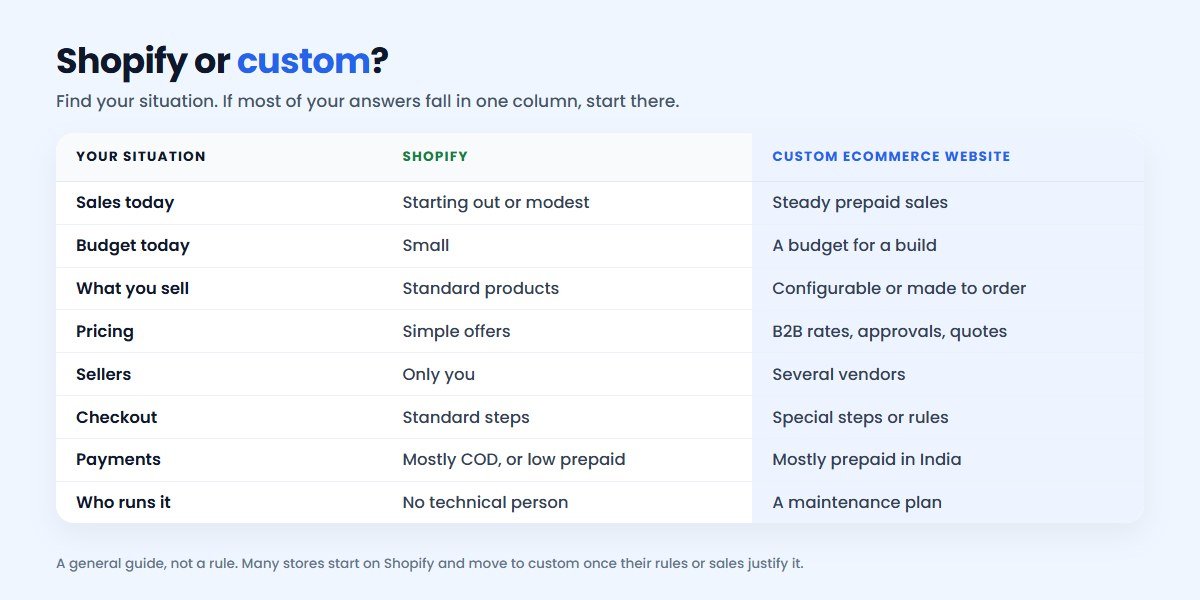
For most small stores, start on Shopify. It is cheaper to begin, fast to launch, and good enough for selling products with sizes, colours and offers.
Choose a custom store when the way you sell does not fit a standard store, or when your prepaid sales are large enough that platform costs pay for a build within a reasonable time. If neither is true yet, Shopify is very likely the right answer today.
What Shopify Costs in 2026
These are the plans shown on Shopify's India pricing page on 2 November 2026. Prices change, so treat this as a dated snapshot.
| Plan | Paid monthly | Paid yearly | Third-party payment fee |
|---|---|---|---|
| Basic | ₹1,994/month | ₹1,499/month | 2% |
| Grow | ₹7,447/month | ₹5,599/month | 1% |
| Advanced | ₹30,164/month | ₹22,680/month | 0.6% |
| Plus | From ₹1,75,000/month | Not listed | 0.2% |
The plan is rarely your whole bill. Also budget for:
- A theme. The Theme Store lists 24 free themes. Paid themes on its first listing page ranged from $170 to $500.
- Apps. Reviews, subscriptions, loyalty, bundles and WhatsApp alerts are often paid apps, and these monthly costs add up.
- Setup. Someone has to load products, set up shipping and taxes, and adjust the theme. That is your time or a developer's.
The Fee Indian Stores Often Miss
Shopify Payments is Shopify's own payment service. It works in the US, the UK, the UAE, Canada, Australia and much of Europe, but India is not on the supported list. Shopify says that if your country is not listed, "you need to use a third-party payment provider".
So an Indian store uses a gateway such as Razorpay, and pays two charges on each prepaid order:
- The gateway's fee. Razorpay's pricing page lists 2% plus GST. You pay this kind of fee on any store, Shopify or custom.
- Shopify's third-party transaction fee. This is 2% on Basic, 1% on Grow, 0.6% on Advanced and 0.2% on Plus. A custom store has no such fee.
Here is the good news: Shopify says this fee does not apply to manual payment methods, including cash on delivery. If most of your orders are COD, the fee matters much less. Check your own mix of prepaid and COD orders before you worry about it.
This table shows what Shopify would cost in a year at three sales levels. "Online sales" means prepaid sales through a gateway, and the plan is paid yearly.
| Prepaid sales a month | Best-value plan | Plan cost a year | Fee a year | Shopify total a year |
|---|---|---|---|---|
| ₹1,00,000 | Basic | ₹17,988 | ₹24,000 | ₹41,988 |
| ₹5,00,000 | Grow | ₹67,188 | ₹60,000 | ₹1,27,188 |
| ₹20,00,000 | Grow | ₹67,188 | ₹2,40,000 | ₹3,07,188 |
This is simple arithmetic on Shopify's published prices, before apps, themes and gateway charges. One useful detail: at ₹4,10,000 of prepaid sales a month, Basic and Grow cost the same. Above that level, Grow is the cheaper plan.
Selling from outside India? In countries where Shopify Payments works, you can avoid this fee by using it, so the numbers above do not apply to you. Compare card rates and plan prices for your own country instead.
What a Custom Ecommerce Website Costs
A custom store is a one-time build, followed by running costs. Our estimates for an e-commerce store start at ₹20,000 – ₹80,000 for a smaller store and ₹40,000 – ₹1,60,000 for a larger one, before add-ons. Those figures are a starting point, and a store with marketplace features or a lot of custom logic can cost more. You can check your own project in our cost calculator, or read the full e-commerce website cost guide.
The final price depends on:
- Catalogue size, variants, filters and search.
- Pricing rules, such as bulk discounts or a separate price for each customer type.
- Checkout steps, such as COD rules, part payments or delivery slots.
- Integrations with couriers, stock systems, accounting software or a CRM.
- Seller features, if several vendors sell on your site.
- Design, whether adapted or made from scratch.
After launch you pay for hosting, your gateway, backups and a maintenance plan for security updates and fixes. Do not skip this. On Shopify, these jobs are part of the subscription. On a custom store, they are yours.
Want a real number for your store? Get an estimate in about a minute, or talk to our team for a written scope.
How to Work Out Your Payback
A custom store only pays for itself if it saves more each year than it costs to run. Use this simple sum:
Payback time = extra build cost ÷ (yearly Shopify cost − yearly cost of running the custom store)
Here is an example with sample numbers, not a quote. Say a custom store costs ₹1,00,000 more to build than a Shopify setup, and ₹40,000 a year to host and maintain.
- ₹1,00,000 a month in prepaid sales: you save only ₹1,988 a year. Stay on Shopify.
- ₹5,00,000 a month: you save ₹87,188 a year, so the extra cost is back in about 14 months.
- ₹20,00,000 a month: you save ₹2,67,188 a year, so it is back in under 5 months.
Run the sum with your real numbers, and add your monthly app bills to the Shopify side. Saving fees should not be your only reason, though. A custom store also has to sell as well as your current store does, and a weak build can lose more in sales than it saves in fees.
Side-by-Side Comparison
| Shopify | Custom ecommerce website | |
|---|---|---|
| Time to launch | Days to a few weeks | Often 1 to 3 months |
| Day-one cost | Low | Higher |
| Monthly cost | Plan, apps and fees | Hosting and maintenance |
| Fee on prepaid sales in India | 0.2% to 2%, plus gateway | Gateway only |
| Checkout changes | Limited below Plus | Built as you need |
| B2B and special pricing | Possible with apps or higher plans | Built around your rules |
| Security and updates | Handled by Shopify | Handled by your developer |
| Ready-made add-ons | Large app store | Built or integrated as needed |
| Biggest risk | Fees and apps grow with you | A weak developer or no maintenance |
Checkout, Ownership and Other Limits
Checkout
On Basic and above, you can add your logo, colours and fonts to the checkout, and use eligible apps on the thank you and order status pages. Apps that change the information, shipping and payment steps are only available on Shopify Plus, which starts at ₹1,75,000 a month. If your business needs special steps at checkout, this limit can decide the whole question.
Ownership
Your products, customers and orders are yours, and you can export them. Your theme, however, is written for Shopify and will not run elsewhere, so moving means a rebuild. Shopify keeps your store information for 2 years after you deactivate it. Its terms also say it may "cancel an existing Account, for any reason, at our sole discretion". That is rare for a normal business, but you should know it, especially if you sell restricted products.
With a custom store you can own the code, but only if your contract says so. Ask for a written transfer of ownership once the project is paid for, and keep the hosting, domain and code accounts in your company's name. Our guide to choosing a freelancer, a company or an in-house team explains this under Indian law.
Upkeep
This is Shopify's strongest point. You never think about servers, traffic spikes during a sale or security patches. A custom store can handle these well, but someone has to be responsible for them.
When Shopify Is the Better Fit
Shopify is usually the right choice when:
- You are launching a new brand and want to test demand.
- You sell standard products with sizes, colours and simple offers.
- Your monthly prepaid sales are modest, or most orders are COD.
- You have no technical person and do not want to manage one.
- You want to spend your budget on marketing and stock, not software.
- The apps you need already exist.
In these cases a custom build would be solving a problem you do not have yet. Our Shopify development team can set up a store that looks like your brand, not a template, and you can always move later.
When a Custom Ecommerce Website Is the Better Fit
A custom store usually makes sense when:
- You sell B2B, with price lists, approvals, quotations or credit terms for each customer.
- You run a marketplace, with several sellers, commissions and payouts.
- Your products need special handling, such as configurators, made-to-order items or rental dates.
- Your checkout is unusual, and Shopify Plus is too expensive for your size.
- Your stock lives elsewhere, in a warehouse system, ERP or POS that must stay in step with the store.
- Your platform costs have grown past what a build and maintenance plan would cost.
Our E-commerce Services, With Real Projects
Here is what CodeBase Coders builds. Each example is a real client project, and you can open its case study for details.
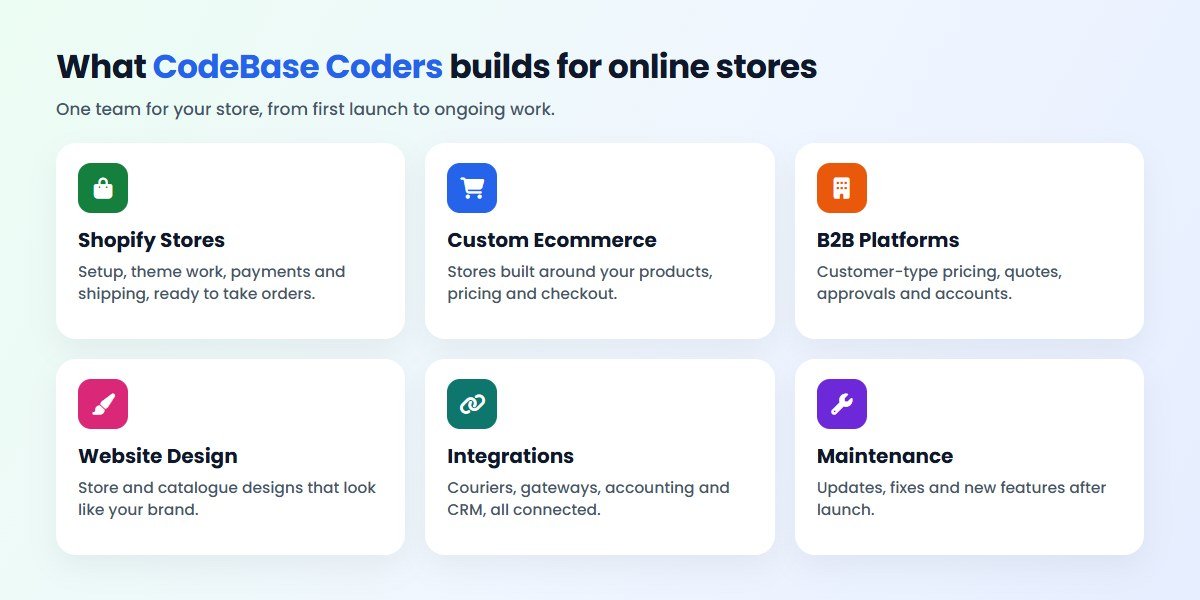
Shopify Store Development
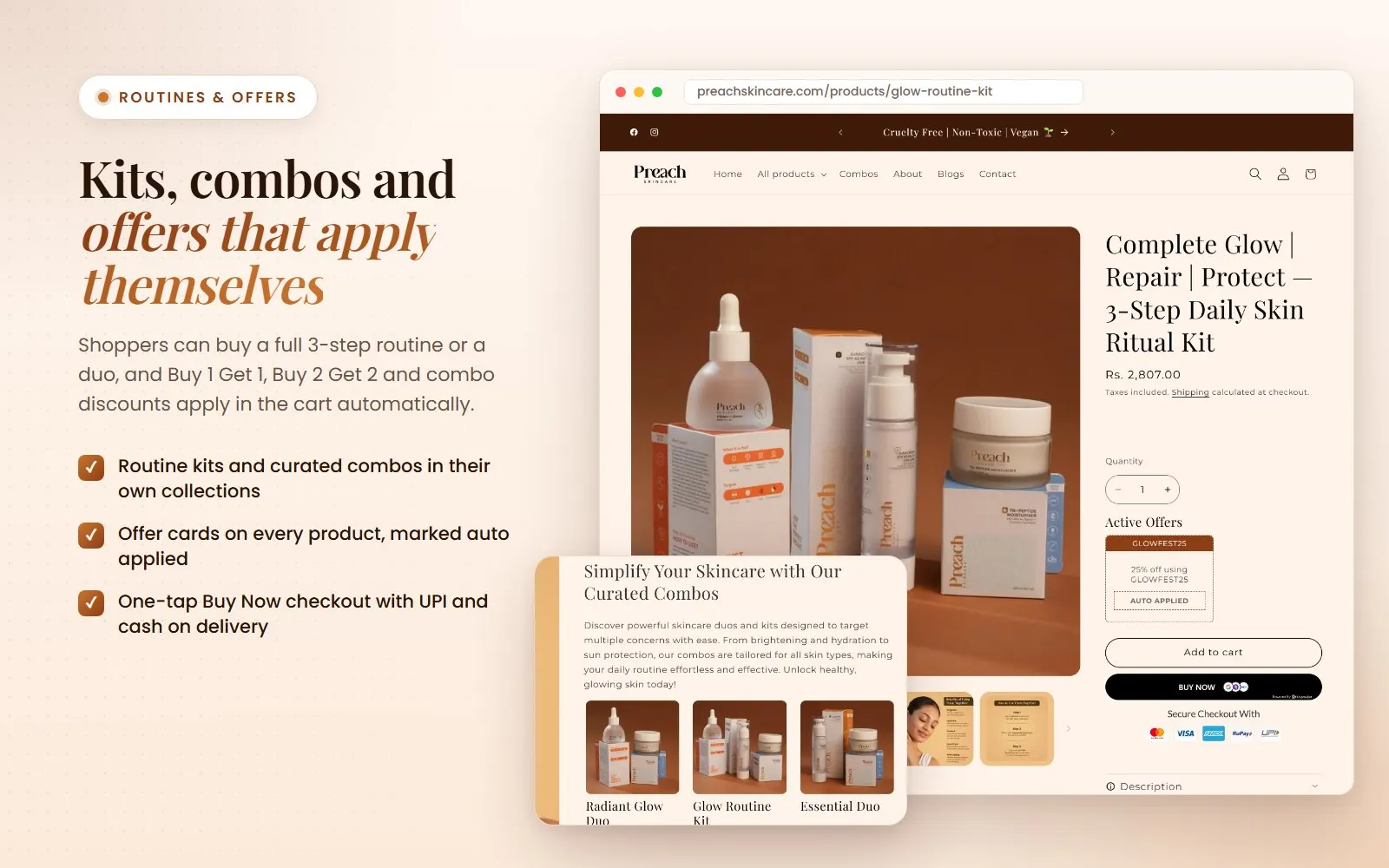
Store setup, theme work, payments and shipping, ready to take orders. Preach Skincare is a Shopify store with detailed product pages, routine kits and combos, and offers that apply automatically in the cart. See Shopify development or hire Shopify developers.
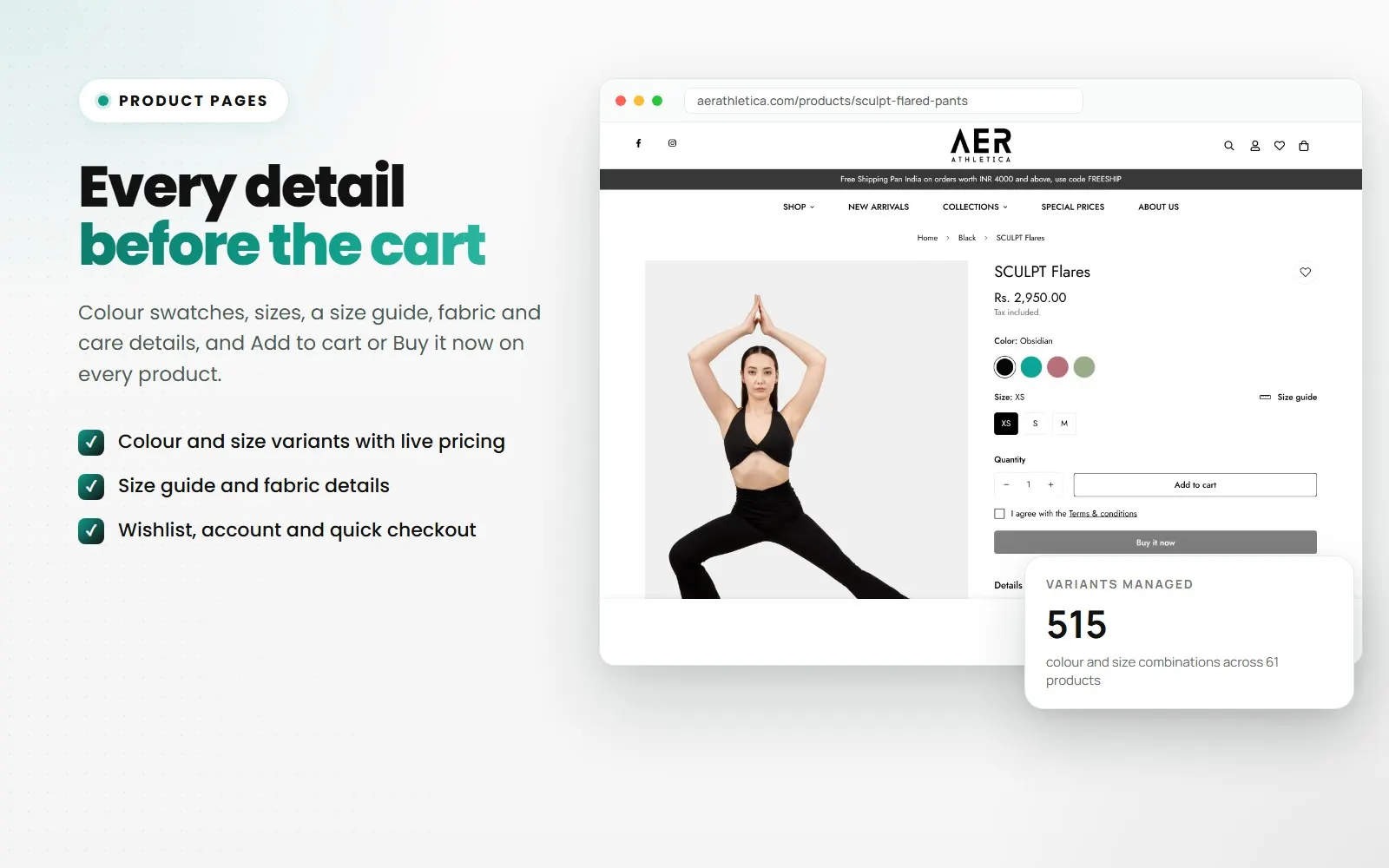
Aer Athletica shows what Shopify does well for fashion: filters for size, colour and price, colour swatches, size guides and matching sets. See the case study.
Custom E-commerce and B2B Platforms
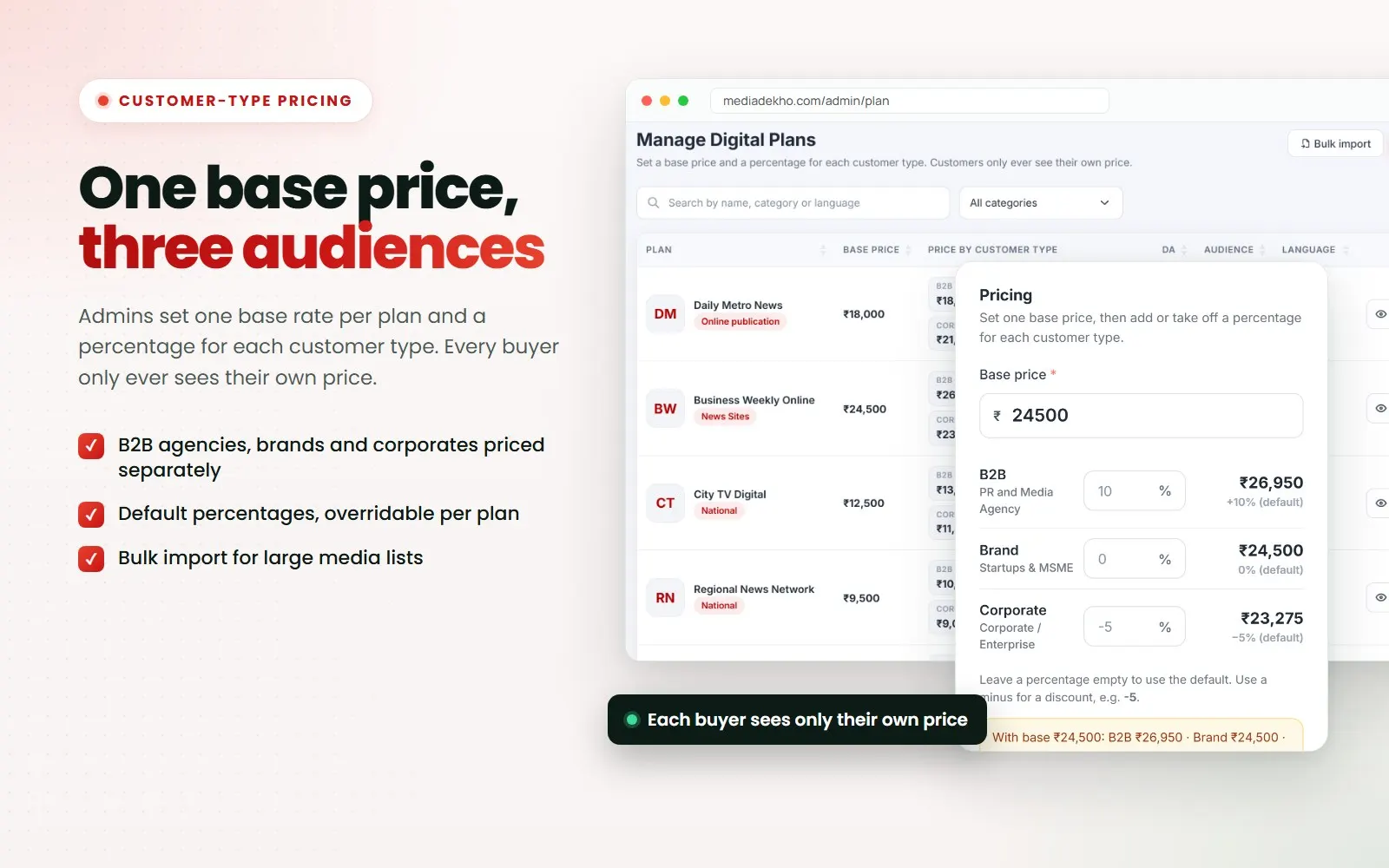
When buying rules are too complex for a standard store. Media Dekho is a B2B platform with over 150 media plans, where agencies, brands and corporates each see their own price, then request a quote or pay online. See e-commerce website development.
B2B Catalogue Websites
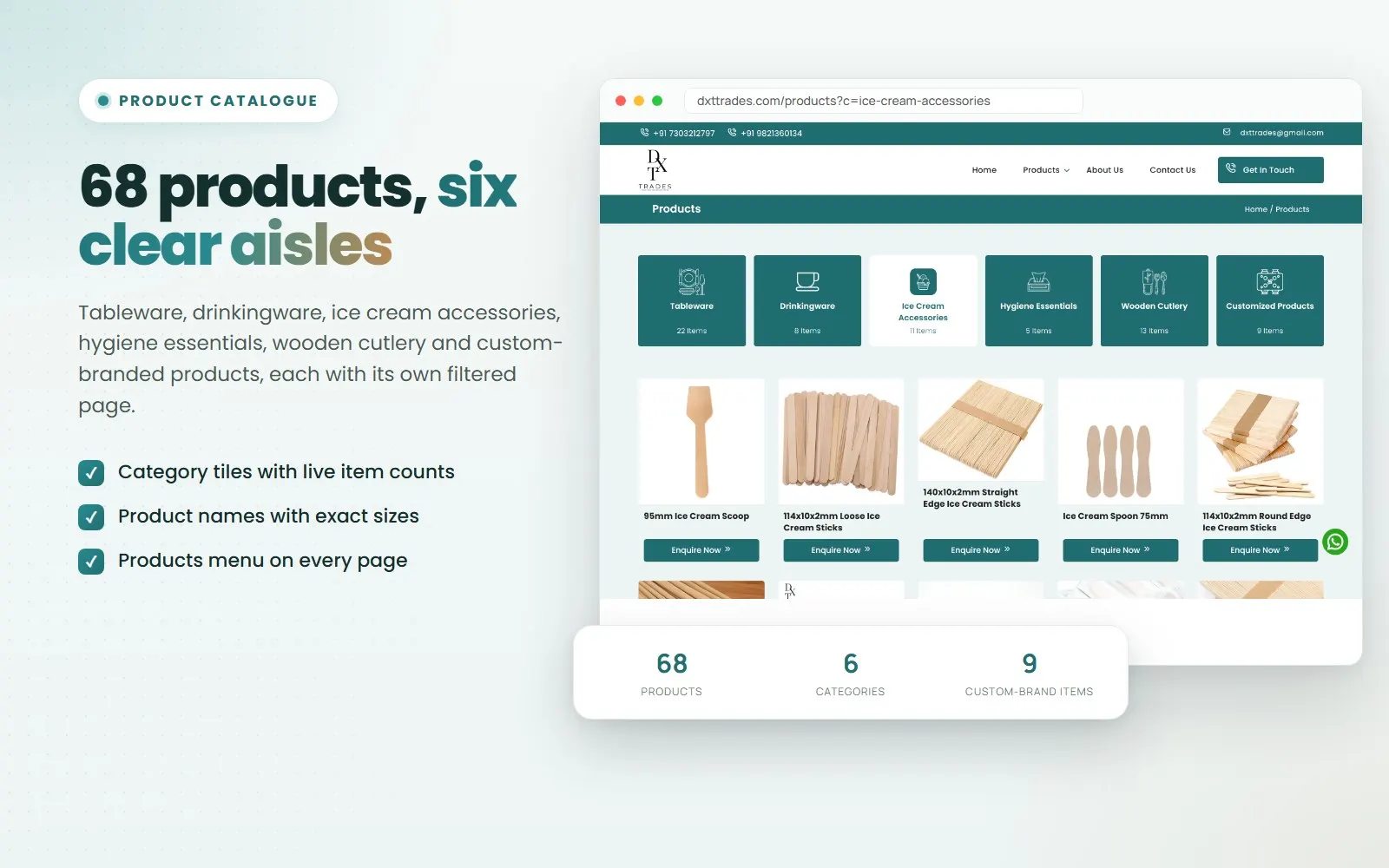
Not every business needs a cart. DXT Trades sells packaging in bulk, so its site is a catalogue of 68 products where each Enquire Now button opens a form with that product already filled in. See the case study or our website design services.
Integrations and Ongoing Work
We connect stores to couriers, payment gateways, accounting and CRM systems through our integration services. If you want your own team on the job, you can hire Laravel developers directly.
Not sure which suits your store? Book a free call and we will tell you honestly, or ask for a free audit of your current store.
How to Move From Shopify to a Custom Store
A careful move protects your sales and your search rankings:
- Export your data. Download products, customers and orders from your Shopify admin.
- List what you use. Note every app, automation and report, and decide which you still need.
- Build and test. Place real test orders with each payment method, including COD and refunds.
- Keep your URLs working. Shopify uses paths like /products/ and /collections/. Keep them, or set up 301 redirects from every old URL.
- Plan customer logins. Passwords usually cannot be moved, so tell customers how to set a new one.
- Switch at a quiet time. Avoid sale periods, and move your domain only after final checks.
- Keep Shopify briefly. Do not close it until the new store has proved itself.
Questions to Ask Before You Decide
- How much of our revenue is prepaid, and how much is COD?
- What will our plan, apps and fees cost in a year at our target sales?
- Which part of our selling process does not fit a standard store?
- Do we need to change the checkout, and would that require Shopify Plus?
- Who will fix the store if it goes down during a sale?
- For a developer: who owns the code, and are the accounts in our name?
- What is the payback time with real numbers, not hopeful ones?
Conclusion
The Shopify vs custom ecommerce website decision comes down to how you sell and how much. Shopify is the sensible start for most stores, with low setup cost and little to manage. A custom store earns its cost when your rules do not fit a standard store, or when your prepaid sales make platform fees larger than a build and maintenance plan.
Work out your real yearly cost, then decide. If you want a second opinion, talk to us. Our team works from Noida, meets clients in Delhi NCR, and works online with businesses across India and abroad. If Shopify is enough for you, we will say so.
Frequently Asked Questions
Is Shopify better than a custom website?
For most small stores, yes, because it is faster and cheaper to start. A custom website is better when your pricing, checkout or selling process does not fit a standard store.
Is Shopify cheaper than a custom ecommerce website?
At the start, usually yes. Over time it depends on your sales, because Indian stores pay Shopify a fee on prepaid orders, and apps add monthly costs. Use the payback sum above.
Does Shopify charge a fee on cash on delivery orders?
No. Shopify says third-party transaction fees do not apply to manual payment methods, which include cash on delivery.
Is Shopify Payments available in India?
India is not on Shopify's list of supported countries, so Indian stores use a third-party gateway such as Razorpay, and Shopify's third-party transaction fee applies to those payments.
How much does a custom ecommerce website cost in India?
Our estimates start at ₹20,000 – ₹80,000 for a smaller store and ₹40,000 – ₹1,60,000 for a larger one, before add-ons. The final price depends on your features and is confirmed in a written scope.
Can I move from Shopify to a custom website later?
Yes. You can export products, customers and orders, but the design must be rebuilt. Plan 301 redirects so that you keep your search rankings.
How can CodeBase Coders help me choose between Shopify and a custom ecommerce website?
Tell us what you sell, your monthly orders and what your current setup cannot do. On a free call we will say honestly which option fits, and we build both, so we have no reason to push one. You get a written scope and quote before you pay anything. See our e-commerce website development service.
Sources
- Shopify India: pricing (checked 2 November 2026)
- Shopify Help: supported countries for Shopify Payments
- Shopify Help: third-party transaction fees
- Shopify Help: checkout customization by plan
- Shopify Help: pausing or deactivating a store
- Shopify: terms of service
- Shopify Theme Store (checked 2 November 2026)
- Razorpay: pricing (checked 2 November 2026)
Work With CodeBase Coders
CodeBase Coders is a software development company in Noida that builds Shopify stores, custom ecommerce websites and business websites for brands and growing businesses in India and abroad. You own the code, design and accounts once the project is paid for.
- E-commerce Website Development
- Shopify Development
- Website Design Services
- AI Website Development
- Software Integration Services
- Hire Shopify Developers
- Hire Developers
Further reading: Shopify alternatives in India and UPI charges for merchants.
Planning a store? Book a free consultation and get a written scope before you pay anything, check the cost yourself, or ask for a free audit of what you have today.
Rohan Verma
Founder, CodeBase CodersRohan Verma is the founder of CodeBase Coders. He helps startups, SMEs and enterprises turn ideas into scalable digital products and improve business processes through custom software, AI, automation, integrations and modern web technologies.